The four free addition worksheets below cover everything a kindergartner needs: counting to 20 (the prerequisite), ten frames, number bonds to 10, and picture addition within 20. Print them in this order, or make your own in the free generator by choosing Addition, a max sum of 10 or 20, and how many problems you want.
- Start within 10. Move to within 20 only when the pairs that make 10 are easy.
- Every sheet uses counters your child can touch and count, not bare numbers.
- Three to six problems a day is plenty. Five minutes, then stop.
- Keep a bowl of buttons next to the worksheet. Using them is not cheating.
- Teach in four stages: real objects, pictures, number line, number sentences.
This page is for parents of 4- to 6-year-olds who typed “addition worksheets” because they want to print something today, not read a lecture first. So the worksheets come first. Each one is pictured so you can see exactly what your child will get before you hit print.
After the sheets there is a short table telling you which one to print for which skill, and then the teaching part: how to move a kindergartner from adding real buttons to writing 7 + 3 = 10, what they should be able to do by the end of the year, and a five-minute routine that fits between breakfast and shoes.
Everything here prints free, no sign-up. I built this site for my own two kids, and these are the sheets we actually use.
Three addition worksheets you will not find anywhere else on this site
These three were built for this guide and appear on no other page. They cover the three steps most kindergarten addition sets skip: starting under five, learning doubles as a shortcut, and working backwards from a known total.
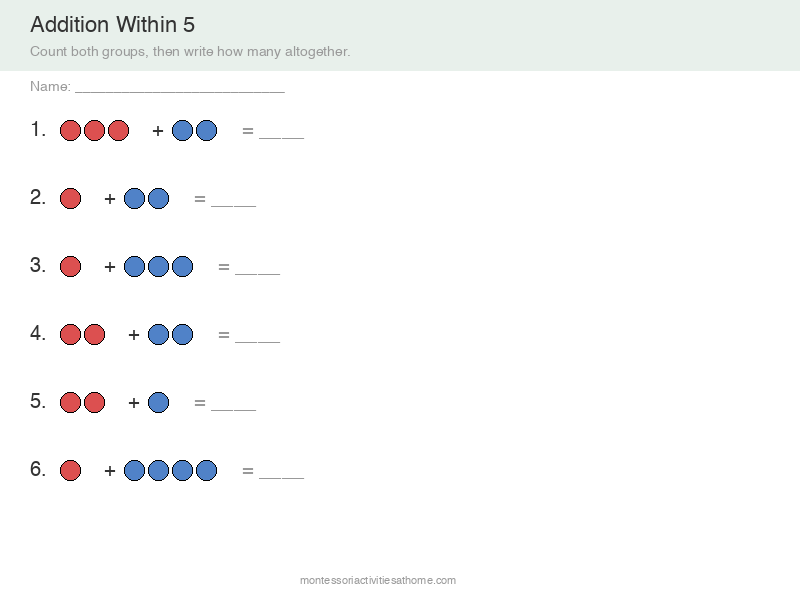
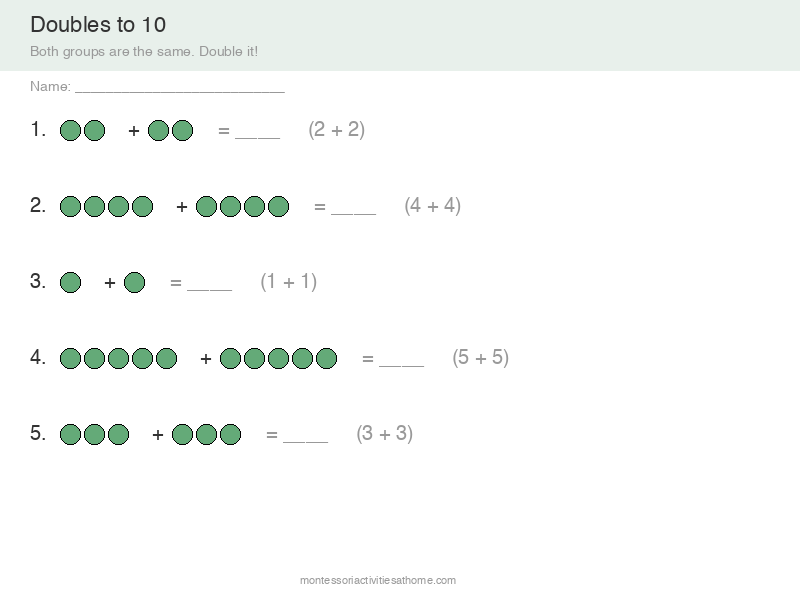
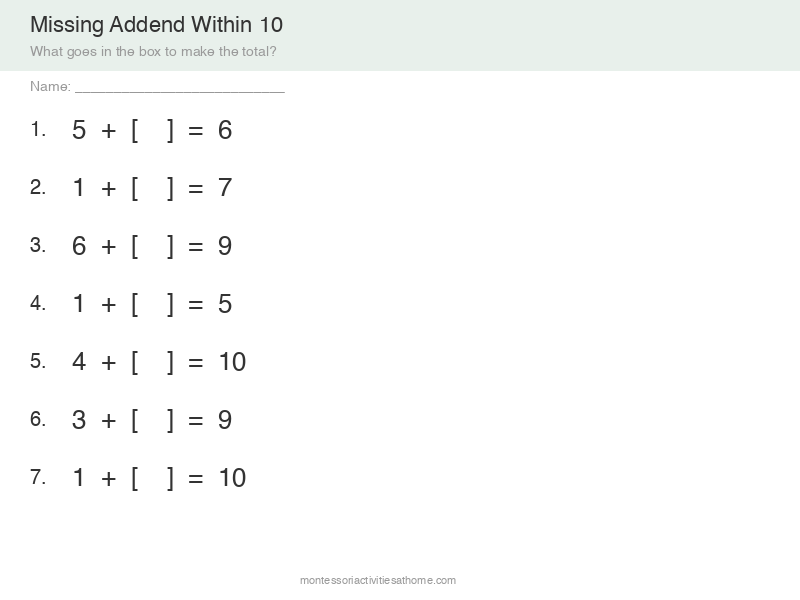
Print all three on plain paper; none needs colour. If your child finds the missing addend sheet hard, that is expected — it is the most demanding of the three and usually lands a few months after the other two.
The worksheets
Four printables, ordered from prerequisite to goal. If your child is already counting to 20 without trouble, skip straight to the ten frames.
1. Addition Within 20 (the main sheet)
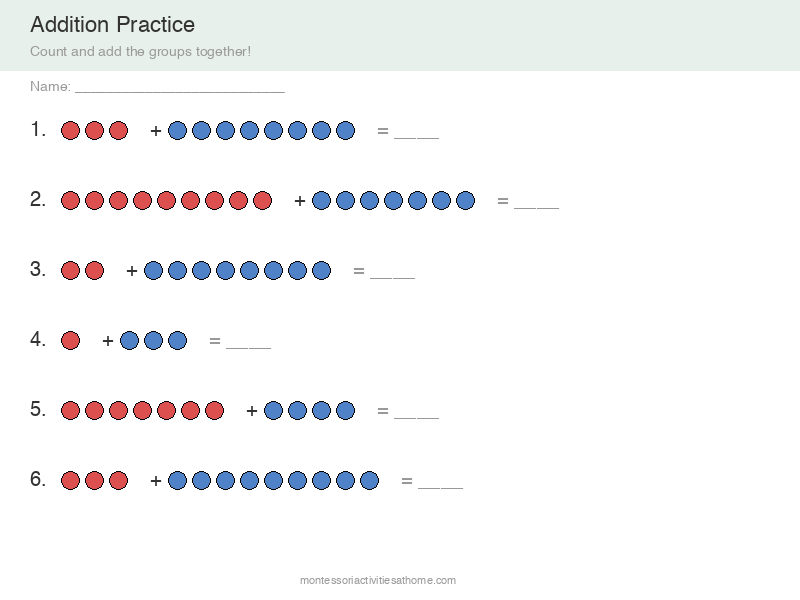
Each row shows a group of red counters, a plus sign, a group of blue counters, and a blank. Your child counts the red, counts the blue, then counts everything to find the total. The two colors matter: they keep the two addends visually separate, which is exactly what a kindergartner needs when the idea of “combining two groups” is still new. Sums run past 10 on several rows, so this is the sheet to use once the bonds to 10 are comfortable. If it is too hard, use the generator below with the max sum set to 10 and come back to this one in a few weeks.
2. Number Bonds to 10
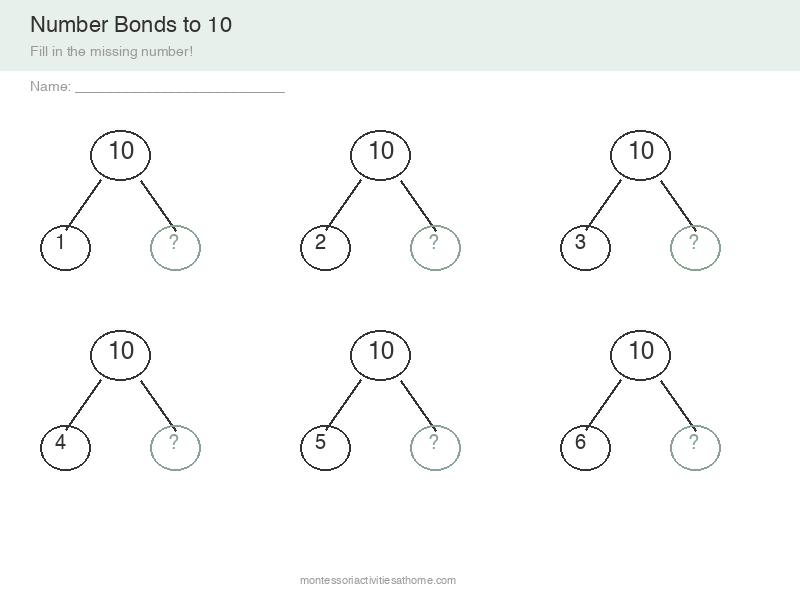
Six diagrams, each with 10 in the top circle, one part filled in (1 through 6), and a question mark for the missing part. This is the single most valuable set of facts a kindergartner can learn. A child who knows that 7 needs 3 to make 10 can later add 7 + 5 by thinking “7 and 3 is 10, and 2 more is 12.” Do this sheet with ten fingers up: hold up the known part, and the fingers still down are the answer.
3. Ten Frames Counting
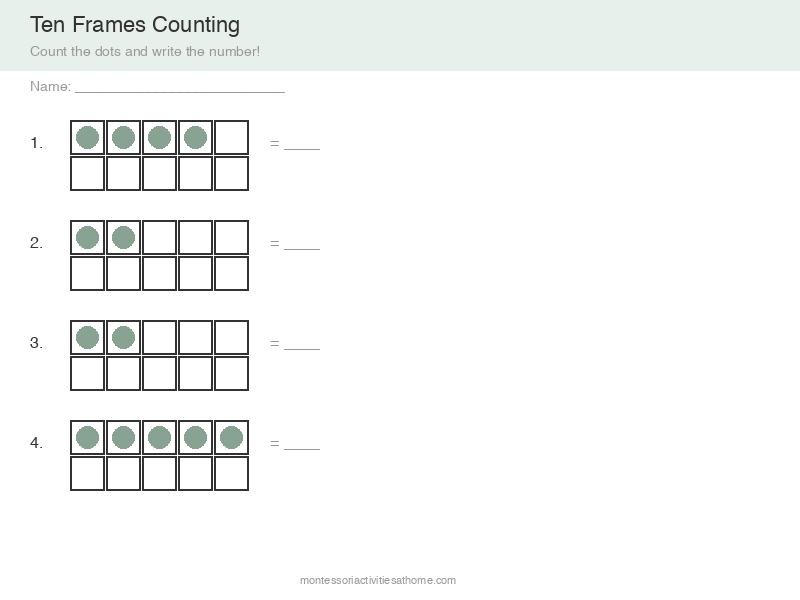
A ten frame is a two-by-five grid. This sheet shows four of them with some boxes filled with dots, and your child writes how many dots there are. It looks like a counting sheet, and it is, but it quietly does two addition jobs. First, the child starts to see 4 or 5 at a glance instead of counting one by one. Second, the empty boxes make the missing part obvious: four dots and six empty boxes is the bond 4 + 6 = 10 before your child has ever seen a plus sign. Ask “how many empty boxes?” on every row.
4. Counting 1 to 20 with Objects (the prerequisite)
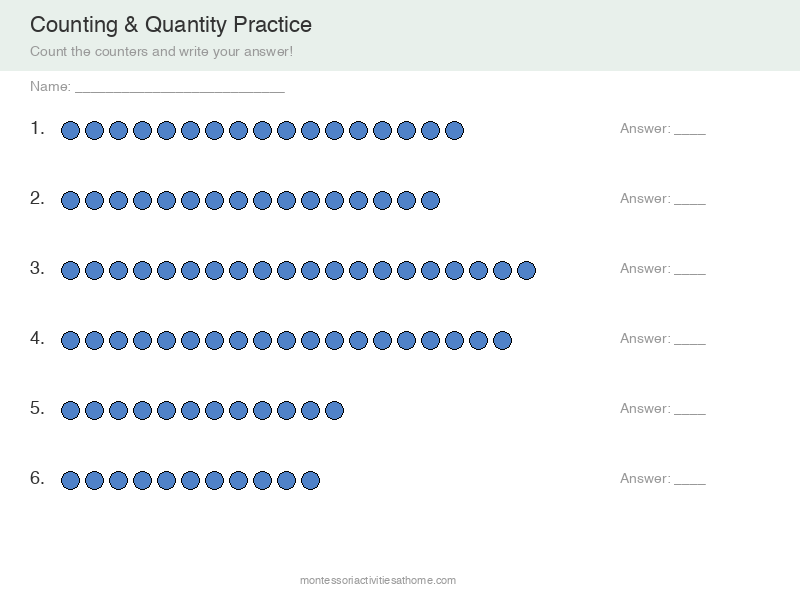
Six rows of blue counters, each between 11 and 20, and a blank to write the total. This is the readiness check. Adding within 20 requires counting to 20 reliably, with one number per counter and no skipping. If your child loses their place in the teens or says “fourteen, sixteen,” spend a week here first.
5. Make your own: unlimited custom addition sheets
The free math worksheet generator makes a fresh addition page every time, so you never run out of practice and never reprint a page your child has memorized. It takes about ten seconds:
- Set Worksheet Type to Addition.
- Set Max Sum to “Up to 10” for most of the year, or “Up to 20” once bonds to 10 are solid.
- Choose the Number of Problems (5 is right for a first sheet, 10 for a confident child).
- Pick a Picture Type: beads, apples, stars, or monkeys. Rotating the picture keeps a five-year-old interested far longer than you would expect.
- Click Generate, then Print.
In our house the generator gets used for the “within 10” weeks, and the printed Addition Within 20 sheet above comes out when we are ready to cross ten.
Which addition worksheet should my kindergartner use?
Use this table to pick one sheet, not all four. Each row also includes a way to check answers together without you becoming the answer key.
| Worksheet | Skill it targets | When to use it | Answer-checking tip |
|---|---|---|---|
| Counting 1 to 20 with Objects | One-to-one counting through the teens | Before any addition. Also a quick check if the addition sheet is going badly. | Have your child touch each counter as they count. If a finger skips or lands twice, recount that row together and stop for the day. |
| Ten Frames Counting | Seeing small quantities at a glance; 10 as a landmark | The first two or three weeks of addition, alongside real objects. | Ask “how many empty boxes?” If the child answers without counting, they already own that bond to 10. |
| Number Bonds to 10 | The pairs that make 10 (1+9, 2+8, 3+7, 4+6, 5+5) | Once ten frames are easy. Revisit weekly all year. | Check with ten fingers: hold up the known part, count the fingers still down. Same answer both ways means it is right. |
| Generator: Addition, max sum 10 | Combining two groups; counting all, then counting on | Daily practice for most of the year. Change the picture type each time. | Print two copies. You do one, with one deliberate mistake. Kids love finding it, and they recount every row to do so. |
| Addition Within 20 | Sums that cross 10; counting on from the bigger group | When bonds to 10 are mostly automatic, usually late in the year. | The answer is simply the total number of counters, so the child can self-check by counting every dot in the row from one. |
📬 Never hunt for printables again
Join the free list and get new worksheets, coloring pages, and activity ideas in your inbox — free, printable, kid-tested.
No spam, unsubscribe anytime.
How to teach addition the Montessori way in 4 stages
Montessori math moves from things you can hold, to pictures of those things, to symbols. For addition that means four stages, and the worksheets above slot into three of them. Most kindergartners spend a few weeks in each stage, but there is no schedule to keep; move on when the current stage looks easy.
Stage 1: Real objects
Two small plates and a bowl of buttons. Put three on one plate and two on the other, then have your child slide them all onto a third plate and count. Say it out loud together: “Three and two make five.” Do this with sums to 5 for a few days, then to 10. No worksheet yet, and no plus sign. The only printable that belongs in this stage is the Counting 1 to 20 sheet, as a check that the counting itself is solid.
You will know this stage is done when your child combines two groups and counts the total without hesitating, and starts to say the answer for tiny sums (2 and 1, 1 and 1) before they finish counting.
Stage 2: Picture addition
Now the buttons become dots on paper. Print a generator sheet with the max sum set to 10 and a picture your child likes, and let them count the first group, the second group, then all of them. Keep the real buttons on the table; if a row is confusing, build it with buttons and then go back to the page. Add the Ten Frames sheet here too, because it introduces 10 as a landmark without adding any new work.
The shift to watch for in this stage is counting on. A child who sees 6 red and 2 blue and says “six... seven, eight” instead of counting all eight from one has made a real leap. Do not force it; model it once in a while and it arrives on its own.
Stage 3: Number line
Write 0 to 20 on a strip of paper, spaced out, and keep it beside the worksheet. For a row showing 5 red and 3 blue, your child puts a finger on 5 and hops forward three times, landing on 8. Then they count the dots to confirm. The number line gives addition a direction (forward), which pays off enormously when subtraction (backward) arrives in first grade.
The one mistake almost every child makes at first is counting the starting number as the first hop, landing on 7 instead of 8. Tape a number line to the floor and let them jump it with their whole body a few times. Standing on 5 and then jumping makes the distinction obvious in a way that fingers on paper do not.
Stage 4: Number sentences
The Number Bonds sheet is already symbolic, so it is the natural first step here. Then take the Addition Within 20 sheet and, before your child starts, write the number sentence next to each row yourself: 3 + 8 = ___. Cover the dots with a strip of paper and ask them to try the sentence alone, using fingers, the number line, or a bond to 10. Then lift the paper and let them count the dots to check. The sheet has become its own answer key, and your child gets to see that the symbols and the pictures agree.
Kindergarten ends here. Fluent, no-support addition within 20 is first-grade work.
What addition should a kindergartner know by the end of the year?
Expectations vary by school and country, and children vary far more than schools do, so treat this as a general picture of what most kindergarten programs work toward rather than a checklist to worry over.
- Adds within 10 using fingers, pictures, or counters, and knows the very small facts (adding 1, adding 2, doubles up to 5 + 5) without counting.
- Knows most pairs that make 10, or can find them quickly on a ten frame or with fingers.
- Adds within 20 with support: pictures, counters, or a number line in front of them. Not from memory.
- Understands what + and = mean and can read a sentence like 4 + 2 = 6 aloud and explain it with objects.
- Solves a simple story problem told out loud: “You had 3 crackers and I gave you 2 more. How many now?”
- Can break a small number into parts: 5 is 4 and 1, or 3 and 2.
If your child is doing most of this comfortably in the spring, they are exactly where they should be. If they are doing all of it in the fall, start the subtraction worksheets; there is no need to hold them at addition.
Signs your child is not ready for addition worksheets yet
None of these are problems. They just mean the worksheet should go back in the drawer for a few weeks while you do more of Stage 1.
- They cannot count ten objects with one number per object. Skipping or double-counting means the counting itself needs more time.
- They do not know which of two numbers is bigger (say, 5 or 8) without counting up to both.
- They do not recognize the numerals 1 to 10 on sight. Worksheets with answer blanks assume they can write the answer they counted.
- They lose interest in under two minutes. A four-year-old who wanders off is telling you the page is too abstract, not that they are bad at math.
- They guess. Random answers with no counting mean the concept of combining two groups has not landed yet, and buttons will fix that faster than paper.
If several of these describe your child, our hands-on preschool math activities are the right place to spend the next month, and the counting worksheets come before any of the sheets on this page.
A 5-minute daily addition routine
Short and daily beats long and occasional. This is the routine that has stuck in our house, done at the same time every day so nobody has to negotiate it.
- Minute 1, warm up. Count to 20 together, then count backward from 10.
- Minute 2, one bond to 10. Hold up some fingers and ask “how many are hiding?” Just one or two of these, not a drill.
- Minutes 3 and 4, three problems. Three rows from whichever sheet fits this week, not the whole page. Buttons on the table, number line beside the sheet.
- Minute 5, one story problem. Something real from their day: “You had 4 grapes and I gave you 3 more.” They answer out loud, no writing.
- Stop. Even if they want more. Especially if they want more. Tomorrow they will come back willingly.
Finish the rest of the sheet over the week, three rows at a time. One printed page lasts two or three days this way, which is another reason five problems is a fine number to generate.
Frequently Asked Questions
Are these kindergarten addition worksheets really free?
Yes. The four worksheets on this page print free with no sign-up, and the math worksheet generator is free to use as well. If you want everything on the site in one place, there is a paid plan on the pricing page, but nothing on this page requires it.
Should a kindergartner do addition within 10 or within 20?
Start within 10 and stay there until the pairs that make 10 feel easy. Most of the kindergarten year is spent within 10. Addition within 20 comes at the end, and it should be done with pictures or counters in front of the child, not from memory.
How many addition problems should a 5-year-old do in a day?
Three to six problems, about five minutes. A short daily session beats a long weekly one. If your child asks to keep going, let them finish the page, but stop while it is still fun rather than pushing to the end.
What is the difference between number bonds and addition facts?
A number bond shows one number split into two parts, like 10 broken into 7 and 3. An addition fact is the same relationship written as a sentence, 7 + 3 = 10. Children who know the bonds to 10 already know those addition facts; the bond diagram just makes the part-and-whole idea visible.
Is it okay for my kindergartner to count on their fingers?
Yes. Fingers are a built-in ten frame and a normal part of learning to add. The next step is to start from the bigger number and count on with fingers only for the smaller number. Finger counting fades on its own as facts become familiar.
Do I need to buy Montessori materials to teach addition at home?
No. Two small plates and a bowl of buttons or dried beans cover the concrete stage. A strip of paper numbered 0 to 20 is your number line. The printable worksheets on this page cover the picture and number-sentence stages.
Print these next
Once the addition sheets above are comfortable, these are the natural next pages:
- Subtraction Within 20 — the same red-and-blue counter style, hopping backward instead of forward.
- Greater Than / Less Than (1 to 20) — comparing two groups, which makes counting on from the bigger number click.
- Number Bonds to 10 — worth reprinting every couple of weeks all year.
- Counting by 5s and Counting by 10s — skip counting for a child who has finished within 20 early.
- Math worksheet generator — set it to Addition or Subtraction, pick the max sum, print a fresh page any morning you need one.