Montessori teaches preschool math in a fixed order: real quantities first, written numerals second, the two matched together third, and only then the teens, skip counting, adding and taking away with objects, comparing, and patterns.
- Quantity before symbol. Knowing what “four” is matters more than being able to write a 4.
- Concrete before abstract. Objects, then pictures of objects, then numerals alone. Worksheets come last in each stage, not first.
- Each of the 8 stages below has one household activity, one free printable that matches it, and the readiness sign that tells you it’s time to move on.
- Minutes, not lessons. Five to fifteen minutes of intentional math a day is plenty between ages 3 and 6.
- Don’t rush counting to 100, the > and < symbols, or pencil work before the hand is ready.
This post is for parents of 3 to 6 year olds who already know that hands-on math is good, and now want to know what to do when. It is not another list of twenty counting games. We already have those: the number recognition activities post covers the games, and the counting worksheets post covers the printables. This one is the map that tells you which of them your child is ready for.
Montessori classrooms teach early math in a deliberate sequence. The materials change (number rods, sandpaper numerals, spindle boxes, teen boards, bead chains), but the logic behind them is simple enough to follow at home with a bag of dried beans and a highlighter. I’ve broken that logic into eight stages a parent can actually see, and matched each one to a worksheet on this site so you print the right thing at the right moment.
Why the order matters more than the activities
A three year old who can chant to thirty but can’t hand you six spoons has learned a song, not math. Montessori splits early number work into three moves: the child experiences quantity (six real things), then learns the symbol (the numeral 6), and only then associates the two. Skip the first move and the symbol is just a shape. Skip the third and the child has two disconnected skills that fall apart on a bad day.
Everything after that (teens, tens, adding, comparing) is the same three moves applied to bigger ideas. So when your child is stuck, the fix is almost never more practice at this level. It is usually “go back one stage and make it concrete again.”
The 8 stages at a glance
Age ranges are rough. Kids enter and leave each stage at very different times, and the readiness sign matters far more than the birthday.
| Stage | Typical age | Hands-on activity (household) | Matching free worksheet | Ready to move on when… |
|---|---|---|---|---|
| 1. One-to-one correspondence, counting to 10 | 2½–4 | Move-it-as-you-count with beans | Count 1 to 5 | Counts 8–10 objects without double-touching and can say “how many” without recounting |
| 2. Number symbols and tracing | 3–4½ | Highlighter numerals, traced in pencil | Number Tracing 1–10 | Names 1–10 on sight, in any order, including on a clock or a sign |
| 3. Quantity ↔ symbol matching | 3½–4½ | Roll a die, slap the sticky-note numeral | Ten Frames Counting | Given a numeral, builds the quantity; given a pile, finds the numeral, both without help |
| 4. Teens and counting to 20 | 4–5 | Ten-and-some-more egg carton | Count 1 to 20, Number Tracing 1–20 | Says “thirteen is ten and three” unprompted and counts to 20 without skipping fifteen |
| 5. Skip counting (linear counting) | 4½–6 | Stacks of ten coins; family fingers by fives | Counting by 10s, by 5s | Counts by tens to 100 and explains that a stack “is ten” |
| 6. Early operations with objects | 4½–6 | Toy-car parking lot: cars arrive, cars leave | Number Bonds to 10, Addition within 20 | Answers “3 and 2 more” by counting on from 3 instead of starting from 1 |
| 7. Comparison (greater / less) | 4–6 | Two handfuls, lined up in matched rows | Greater Than / Less Than 1–20 | Uses “more,” “fewer,” and “same” correctly and can say by how many |
| 8. Patterns and shapes | 3–6 (runs alongside) | Fruit-kebab and cereal-string patterns | Simple Patterns, Basic Shapes | Continues an ABB pattern and names the rule out loud |
Stage 1: One-to-one correspondence and counting to 10
What it looks like at home. Your child recites numbers happily but the count and the objects don’t line up: two beans touched while saying “three,” or “seven” for a pile of five. Normal. One-to-one correspondence (each object gets exactly one number word) has to be built, not assumed.
Try this: move it as you count it. Put a small pile of dried beans on the left side of a placemat. Show your child how to slide one bean to the right while saying “one,” the next while saying “two.” The move is what fixes double-counting, because a bean that has moved can’t be counted again. Start with three or four. When the pile is done, ask “so how many?” If they recount, the last number hasn’t become the answer yet, and that’s fine. Keep going for a few days.
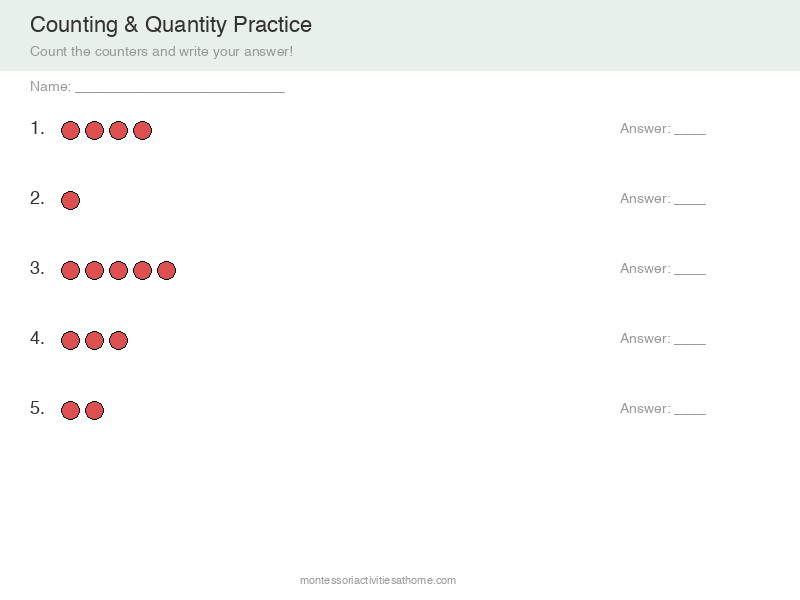
Ready to move on when your child can count out eight to ten objects without skipping or double-touching, and when you ask “how many?” they say the last number instead of counting again.
Stage 2: Number symbols and tracing
What it looks like at home. Your child can count a pile, but a written 4 means nothing to them, or every numeral is “eight.” The classroom answer is sandpaper numerals traced with two fingers. The home version doesn’t need sandpaper.
Try this: highlighter numerals. Write a numeral big (a full hand span) in yellow highlighter. Your child traces over the yellow with a crayon while you say the stroke out loud: “down” for 1, “around and down” for 2. Three numerals at a time; in our house it was 1, 2, and 3 for a week before anything else appeared. The wide yellow path means the child is never “wrong,” and naming the strokes turns a shape into a movement they can remember.
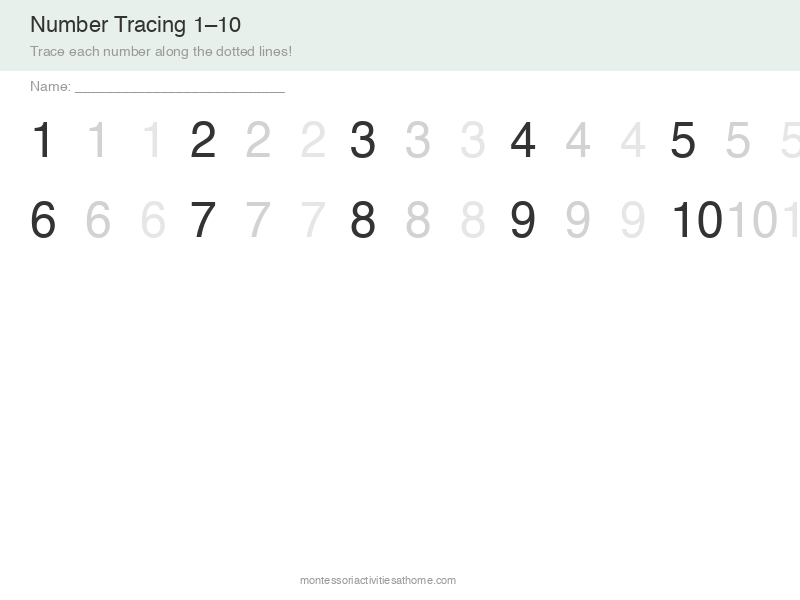
Ready to move on when your child names 1 through 10 on sight, out of order, and starts spotting them in the wild: the microwave, the elevator, a cereal box. Tracing neatness is not the readiness sign. Recognition is.
📬 Never hunt for printables again
Join the free list and get new worksheets, coloring pages, and activity ideas in your inbox — free, printable, kid-tested.
No spam, unsubscribe anytime.
Stage 3: Matching quantity to symbol
What it looks like at home. Your child can count beans and name numerals, but asks “which one is five?” when handed five things and a row of number cards. The two skills exist separately. This stage glues them together, and it’s the one most families skip by accident.
Try this: roll and slap. Stick six sticky notes on the wall at kid height, numbered 1 to 6. Your child rolls a die, counts the dots (touching each one), then runs and slaps the matching numeral. The die gives quantity, the wall gives symbol, the run keeps them playing for twenty rolls. Flip it the next day: you call a numeral, they build that many blocks. Both directions matter; pile-to-numeral and numeral-to-pile are separate little skills.
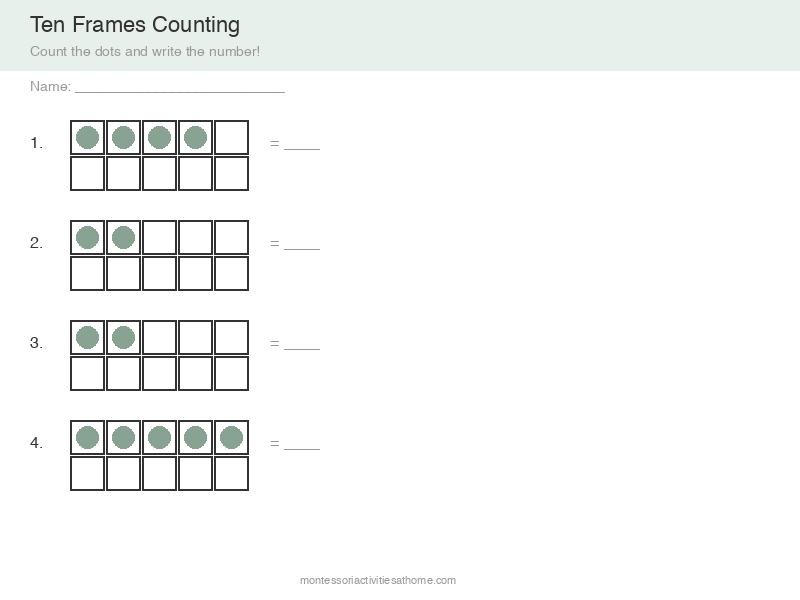
Ready to move on when your child can go both ways without help: show a numeral, they build the quantity; show a pile, they find the numeral. When the die comes out and they slap the wall before you’ve finished asking, they’re done here.
Stage 4: Teens and counting to 20
What it looks like at home. Counting stalls around twelve. Fifteen disappears. “Eleventeen” shows up. None of this is a math problem; it’s an English problem. “Sixteen” at least hints at six-and-ten, but “eleven” and “twelve” are pure memorization and “thirteen” and “fifteen” are mangled. Montessori’s teen board exists to make the hidden ten visible.
Try this: the ten-and-some-more egg carton. Cut a dozen egg carton down to ten cups and fill every cup with a bean. Put three loose beans beside it: “Ten, and three more. Thirteen.” Swap the loose beans: ten and four, fourteen. Always ten-and-something first, the teen word second. After a few days ask your child to make “sixteen” and watch whether they reach for the full carton first. When they do, they understand the structure, not just the names.
Two printables match this stage. Count 1 to 20 with Objects extends stage 1 past ten. Once the teens make sense, Number Tracing 1–20 extends stage 2: writing “13” as a 1 followed by a 3 finally makes sense when the child knows it means ten-and-three.
Ready to move on when your child counts to 20 without dropping fifteen, and, more tellingly, says something like “fourteen is ten and four” without being asked.
Stage 5: Skip counting and linear counting
What it looks like at home. Your child wants to count “really high” and pushes past twenty by pattern (twenty-one, twenty-two…). This is the moment to give them ten as a unit, because the whole decimal system rests on it and it turns counting to 100 into ten steps instead of a hundred.
Try this: stacks of ten. Empty the coin jar and have your child make stacks of ten pennies (good stage 1 practice too, so expect it to take a while). Then count the stacks: “ten, twenty, thirty,” pointing at each one. For fives, use hands: everyone in the room holds up one hand and you count around by fives, then both hands by tens. The hands make the point that skip counting isn’t a chant, it’s a faster way to count real things.
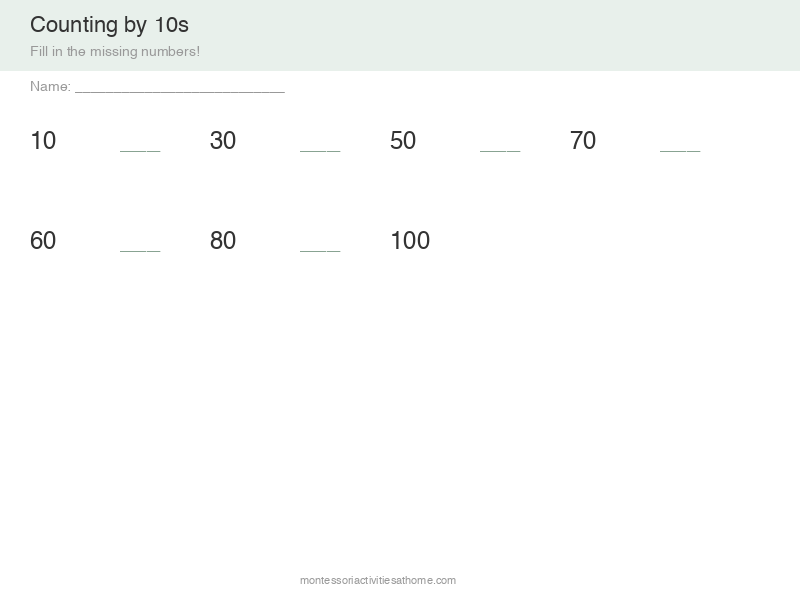
Ready to move on when your child counts by tens to 100 and, if you point at a stack, says “that’s ten” rather than counting the coins.
Stage 6: Early operations with objects
What it looks like at home. “How many if one more comes?” gets a real answer instead of a guess. Your child is ready to combine and take away, but with things they can hold. No equations yet. The Montessori materials here (number rods laid end to end, the addition strip board) are all about seeing two quantities become one.
Try this: the parking lot. Draw ten parking spaces on cardboard, two rows of five. Toy cars arrive: “three parked, two more pull in, how many now?” Cars leave: “five parked, two drive away.” Your child moves the cars and narrates. Two rows of five is a ten frame in disguise, so “how many empty spaces?” quietly teaches the pairs that make ten. Say “and,” “more,” and “take away” for weeks before “plus” and “minus.” Vocabulary can catch up later; understanding can’t.
When the cars are easy, Number Bonds to 10 is the first paper step, because it is the parking lot’s empty spaces written down. Addition within 20 and Subtraction within 20 are for five and six year olds already comfortable here. Most four year olds shouldn’t see them yet. When they are ready, the free printable addition worksheets for kindergarten guide walks through introducing addition in four stages, and the free printable subtraction worksheets for first grade guide does the same for six subtraction strategies.
Ready to move on when your child solves “three and two more” by counting on from three (“four, five”) instead of starting from one. Counting on is the first sign a number has become a unit in their head, not just the end of a count.
Stage 7: Comparison, greater and less
What it looks like at home. Your child already compares constantly (“he got more!”), but by eye. This stage turns the instinct into a method, and the method is matching, not counting. Montessori children compare number rods side by side; we do the same with beans.
Try this: two handfuls, two rows. You and your child each grab a handful of beans and line them up in two rows, one bean directly across from one of the other person’s. Whoever’s row sticks out has more. “By how many?” is just the beans without a partner. Only then count to check. This teaches that comparison is about pairing, which is exactly what > and < will mean later. Use more, fewer, and the same, and skip the symbols until this is easy with objects.
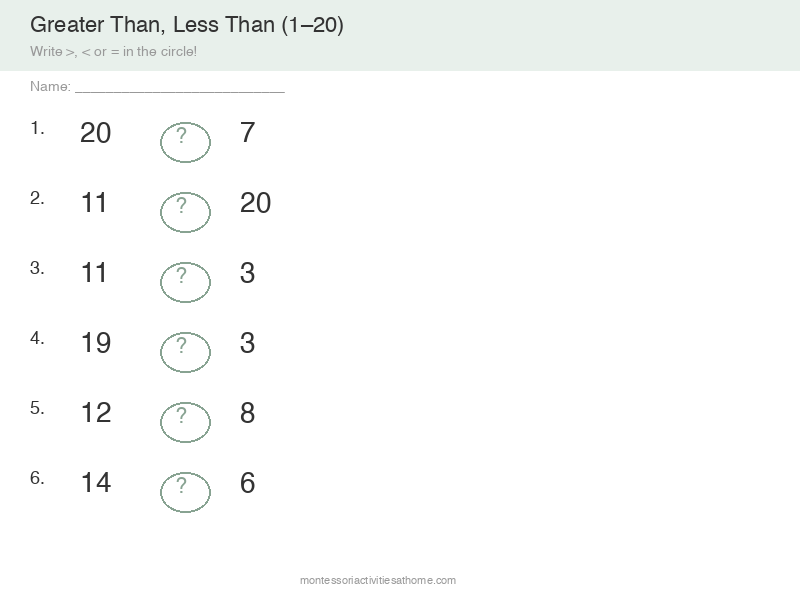
Ready to move on when your child uses “more,” “fewer,” and “same” correctly and can tell you by how many, using the rows. The symbols can be introduced after that, usually around five or six.
Stage 8: Patterns and shapes
What it looks like at home. This stage runs alongside the others from age three rather than after them. Patterns are pre-algebra, shapes are pre-geometry, and a three year old can do both while the number stages are still cooking. A child who notices “red, blue, red, blue” is already doing math.
Try this: fruit kebabs and cereal strings. Start a pattern on a skewer or string: grape, strawberry, grape, strawberry. Hand it over and ask what comes next. Then make one they haven’t seen: grape, grape, strawberry (ABB). The key move is asking them to say the rule out loud, because naming the pattern is the abstract step. For shapes, do the same with cut cheese or bread: square, triangle, square, triangle. Then it’s snack.
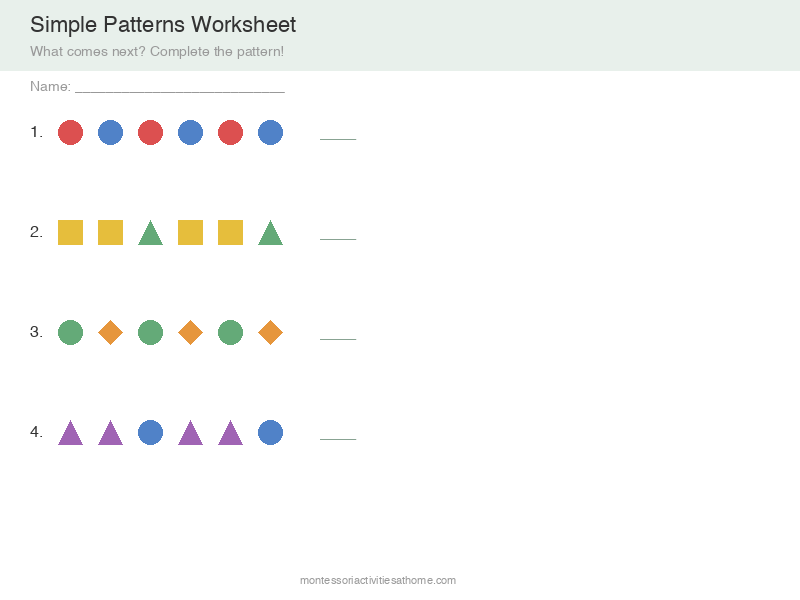
Ready to move on when your child continues an ABB or ABC pattern and tells you the rule, and names circle, square, triangle, and rectangle without hesitating. From there, the rest of geometry is vocabulary and time.
What not to rush
Each of these looks like progress. Each one, done early, costs you a stage you’ll have to go back and rebuild.
- Counting to 100 before counting 10 objects. Rote counting is a party trick until one-to-one correspondence is solid. The child who chants to 100 but miscounts seven beans needs stage 1, not applause.
- Pencil tracing before the hand is ready. A three year old with a fist grip will hate tracing and learn to hate numbers with it. Finger or chunky crayon on highlighter first. Neatness is a fine-motor skill, not a math skill.
- The teens before ten is rock solid. If ten isn’t an obvious unit in your child’s mind, “ten and three” is meaningless and the teens become twenty new words to memorize.
- The > and < symbols. Alligator mouths are cute and completely abstract. Rows of beans first; symbols at five or six.
- Written equations. “3 + 2 = 5” on paper is stages 2, 3, and 6 all at once. Do it with cars for months first. Most preschoolers never need to see a plus sign.
- Worksheets as the starting point. In every stage above, the sheet comes after the objects. If a sheet is frustrating, it’s almost never the sheet. Go back to the beans.
- Anything timed. Speed is a school thing. At home, a slow, correct count is the goal.
How much math per day for a preschooler?
Minutes, not lessons. What worked for us was about five minutes of something intentional for a three year old, ten to fifteen for a five or six year old, and letting the rest happen inside ordinary life: counting the stairs, one napkin per chair, checking whether everyone got the same number of strawberries. That incidental math isn’t a bonus. It’s where most of the learning lands, because the child has a reason to care about the answer.
Two rules of thumb. Stop while they still want more; a child who ends happy comes back tomorrow. And a worksheet at this age is a two- to five-minute activity, one page, done sitting next to you. If they ask for a second page, print it. If they don’t, the first one did its job. Unsure which stage you’re in? Pick the one that seems too easy. You’ll know in ninety seconds.
Frequently Asked Questions
What order should I teach math to a preschooler?
Follow the Montessori order: counting real objects to 10 first, then written numerals, then matching quantity to numeral. After that come the teens, skip counting, combining and taking away with objects, comparing, and patterns and shapes. The rule under every step is quantity before symbol and concrete before abstract.
How much math should a preschooler do each day?
Minutes, not lessons. About five minutes of intentional math for a three year old and ten to fifteen for a five or six year old, plus the counting that happens naturally during the day. Stop while your child is still enjoying it. A worksheet is a two- to five-minute activity at this age, not a session.
When is a preschooler ready for number tracing worksheets?
When they name most numerals 1 to 10 on sight, count a small handful of objects accurately, and hold a crayon with a controlled grip, usually somewhere between three and a half and five. Start with Number Tracing 1–10 and move to Number Tracing 1–20 once the teens make sense as ten and some more.
My four year old counts to 20 but can’t count seven objects. Is that normal?
Very normal. Reciting the sequence is a memorized song; counting objects needs one-to-one correspondence, a separate skill. Go back to stage 1 and have your child move each object as they say each number. Once they count seven, eight, and nine objects reliably and tell you how many without recounting, the two skills line up.
Do I need Montessori materials like golden beads or spindle boxes at home?
No. Each classroom material isolates one idea, and household objects can isolate the same idea: beans for quantity, a highlighter for numerals, a die and sticky notes for matching, an egg carton for teens, stacks of coins for tens. What matters is the sequence and the concrete-before-abstract rule, not the wooden box.
Print these next
Pick the stage your child is in and print that one sheet. All are free, no sign-up:
- Stage 1–3: Count 1 to 5, then Number Tracing 1–10, then Ten Frames Counting.
- Stage 4–5: Count 1 to 20, Number Tracing 1–20, Counting by 10s.
- Stage 6–8: Number Bonds to 10, Greater / Less Than, Simple Patterns.
- Need a different number range or theme? The math worksheet generator builds a custom sheet for whatever stage you’re on, and the full math library has the rest.