Montessori practical life is a progression, not a list: a child moves from carrying a cloth to the hamper at 12 months, to pouring and wiping at 2, to cutting and folding at 3, to full cooking and table-setting cycles by 5 or 6, across four strands — care of self, care of environment, food preparation, and grace and courtesy.
- Introduce one new skill at a time, only when the current one looks easy and a little boring.
- Present it the Montessori way: slow hands, almost no words, then step back.
- Child-sized real tools matter more than any purchased material.
- Practical life is also indirect preparation for writing and counting: the hand gets ready long before the pencil arrives.
- For a working parent, one anchored daily moment plus one weekend “big work” beats an elaborate shelf you never rotate.
This guide is for the parent who already knows practical life matters and has a bigger question: what comes next? Your two-year-old has been pouring water for months. Is she ready for a knife? Your four-year-old can wipe a table but flatly refuses to fold anything. Is that normal, or did you skip a step?
Our age-specific posts (2 year olds, 3 year olds, 4 year olds) walk through individual activities with materials and steps. This post does the thing those cannot: it lays all five age bands side by side so you can see the staircase. Activity write-ups here are kept short on purpose; when you want the full steps for banana slicing or table washing, follow the links to the age posts.
What are the four areas of Montessori practical life?
Every practical life activity fits into one of four strands. Knowing them helps you notice when a child’s week is lopsided (lots of food prep, no care of self, for example).
- Care of self: dressing, washing, toileting, grooming, blowing a nose, packing a bag.
- Care of environment: wiping, sweeping, tidying, watering plants, feeding pets, laundry.
- Food preparation: pouring, peeling, cutting, spreading, cooking, setting and clearing the table.
- Grace and courtesy: greeting people, saying please and thank you, taking turns, how to interrupt, how to offer help.
Some guides add a fifth, control of movement (walking on a line, carrying a tray). At home it shows up inside the other four, so we fold it in: carrying a full cup is control of movement.
Practical life skills by age: the progression table
Ages are approximate. A child who starts walking at 15 months will hit the 18–24 month column a little later; a second child watching an older sibling often hits it earlier. Read each column as “things that usually become possible around this age,” not a checklist to complete.
| Age | Care of self | Care of environment | Food preparation | Grace & courtesy |
|---|---|---|---|---|
| 12–18 months | Holds own spoon; drinks from a small open cup with help; pulls off socks and hat; lifts arms for a shirt; wipes own face with a cloth | Puts one toy back in a basket; carries a cloth to the hamper; “helps” wipe a spill with a small cloth | Sits at a low table for snack; takes one piece from a small bowl; hands you ingredients; stirs with your hand over theirs | Waves hello and goodbye; hands an object to another person; hears you say “thank you” every time |
| 18–24 months | Takes off shoes and socks; pulls pants down; washes hands on a step stool with help; brushes teeth (you finish); pushes arms into sleeves | Returns toys to one basket; wipes a small spill; carries own unbreakable plate to the counter; waters a plant with a tiny can | Dry pouring (beans, rice) from a small pitcher; peels a banana you have started; puts fruit into a bowl | Gentle hands with pets and babies; waits a few seconds for a turn with a cue from you; begins “please” and “thank you” |
| 2–3 years | Dresses in elastic-waist clothes; velcro shoes; the coat flip; hand washing start to finish; hangs coat on a low hook; blows nose with help | Wipes a table; sweeps into a taped square; puts dirty clothes in hamper; cleans up own spills; puts cushions back | Wet pouring; slices a banana with a butter knife; spreads soft spread on a cracker; washes fruit in a colander; tears lettuce | Greets with eye contact; says “excuse me”; carries a cup with two hands; takes turns with a turn indicator (a stone or stick) |
| 3–4 years | Large buttons; zips once you start it; puts on socks; combs hair; wipes after toileting with a check; packs a small bag from a picture list | Washes dishes at a basin; folds washcloths; pulls up own blanket; dusts a shelf; checks soil before watering; sorts laundry by color | Cuts soft foods (strawberries, cucumber) with a nylon knife; juices an orange; cracks an egg; measures a cup of flour; sets the table for one | Introduces themselves by name; offers food to a guest; says “no thank you”; interrupts with a hand on your arm and waits; apologizes |
| 4–6 years | Small buttons and snaps; attempts laces; brushes teeth thoroughly; bathes with supervision; picks weather-appropriate clothes; packs own school bag | Full table-washing cycle; sweeps a whole room; mops a small area; matches socks; feeds a pet on schedule; takes out recycling; makes bed fully | Follows a picture recipe; whisks eggs; uses a peeler with supervision; assembles a sandwich; pours from a full carton; sets and clears the table for the family; serves themselves | Answers the door or phone with a script; hosts a guest (takes coat, offers a seat); thanks a host; solves a disagreement with words; offers help without being asked |
Notice the pattern down each column: single actions become sequences, and sequences become full cycles. A one-year-old wipes a spill. A three-year-old wipes the table. A five-year-old fetches the bucket, fills it, washes the table, dries it, empties the bucket and hangs up the cloth. Same strand, three levels.
How to present a practical life activity (the Montessori way)
The way you introduce a skill matters as much as which skill you pick. Montessori teachers call this a “presentation,” and the home version has five steps.
- Invite, don’t announce. “I have something to show you. Would you like to see?” Pick a moment when the child is fed, rested and not mid-play.
- Carry the materials together. Everything for the activity lives on one tray or in one basket. The child carries it to the table. This is part of the work, and it defines the beginning.
- Demonstrate slowly, with almost no words. This is the part parents find hardest. Do each movement about half speed. Exaggerate the moments that matter: the pause before you tip the pitcher, the two hands on the cup. Do not narrate. A child cannot watch your hands and process your sentences at the same time.
- Hand it over and step back. “Would you like a turn?” Then sit on your hands. Do not fix the grip. Do not point at the spill. If it is safe, it is fine.
- Complete the cycle. When the child is done, the materials go back to where they came from, ready for next time. The cycle is what turns an activity into a habit.
Two rules run through all five steps. One skill at a time: if you are teaching pouring, do not also teach wiping the spill; add that next week. Isolate the difficulty: if the hard part is the knife, pre-peel the banana so peeling does not get in the way.
📬 Never hunt for printables again
Join the free list and get new worksheets, coloring pages, and activity ideas in your inbox — free, printable, kid-tested.
No spam, unsubscribe anytime.
Chores vs practical life: what’s actually different?
“Isn’t this just getting my kid to do chores?” Sometimes, yes. The task is identical. The setup is not.
| A chore | Practical life | |
|---|---|---|
| Who chooses | Parent assigns it | Child picks from two or three prepared options |
| The goal | The job gets done | The child builds a skill and concentrates |
| The tools | Whatever adults use | Child-sized, real, kept in a fixed spot the child can reach |
| Timing | When the parent needs it done | When the child is interested, with no clock |
| How it is taught | Verbal instructions, often while walking away | A slow, quiet demonstration, then hands off |
| Standard | Adult standard; parent redoes it if needed | The child’s best effort stands as is |
| Repetition | Once, then finished | As many times as the child wants |
| The reward | Allowance, sticker, praise | The work itself; a quiet “you did it” at most |
Chores are not bad. Around five or six, most children can and should have a few. But if your three-year-old has stopped wanting to help, check the right-hand column. Usually one of those rows has slid left.
How practical life builds the hand for writing
Every time a two-year-old squeezes a sponge, transfers beans with a spoon, or picks up a cotton ball with tongs, the same three fingers that will later hold a pencil are getting stronger and more coordinated. Occupational therapists commonly point to exactly these motions, squeezing, pinching, rotating the wrist, as the groundwork for handwriting. Montessori calls this indirect preparation: the child is not learning to write, but the hand is. Direction counts too: wiping a table left to right is the same sweep the eyes and hand will make across a page.
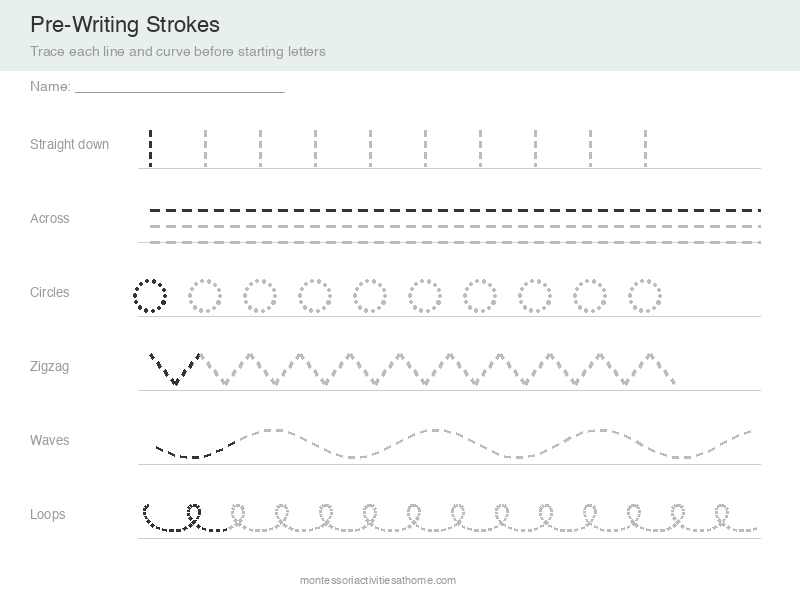
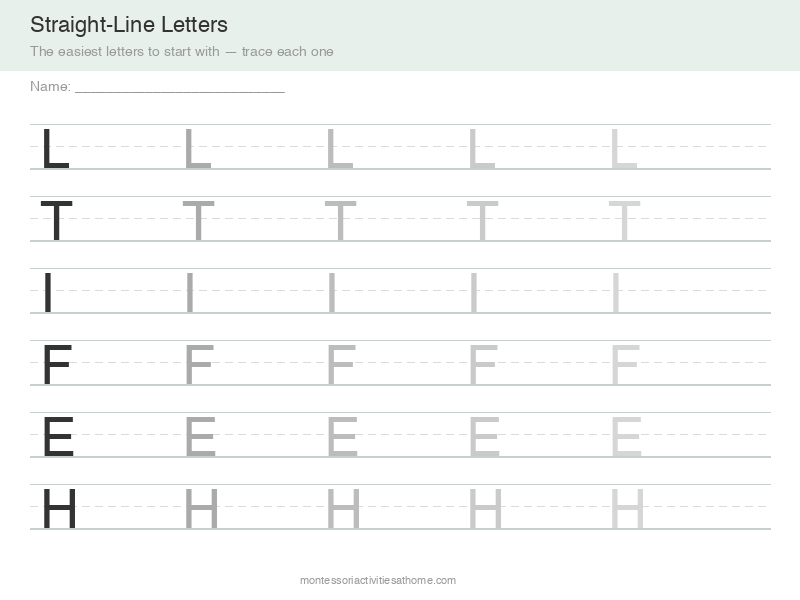
The sequence in our house went roughly like this: a year of pouring, sponging and spooning; then chunky crayons on big paper; then, around three and a half, tracing lines that go straight down or straight across. Straight letters (L, T, I, H) come before curved ones because a straight line is one movement and a curve is a controlled change of direction. A child pushed to letters before the hand is ready grips the pencil in a fist and hates it.
Food prep and setting the table: the hidden math
Food preparation is the strand with the most math hidden in it. “We are four people. How many plates?” is one-to-one correspondence, the idea underneath all counting. “Cut the banana into five slices, one for each of us” is the same idea with a knife. Measuring a cup of flour is a first meeting with quantity and, later, fractions.
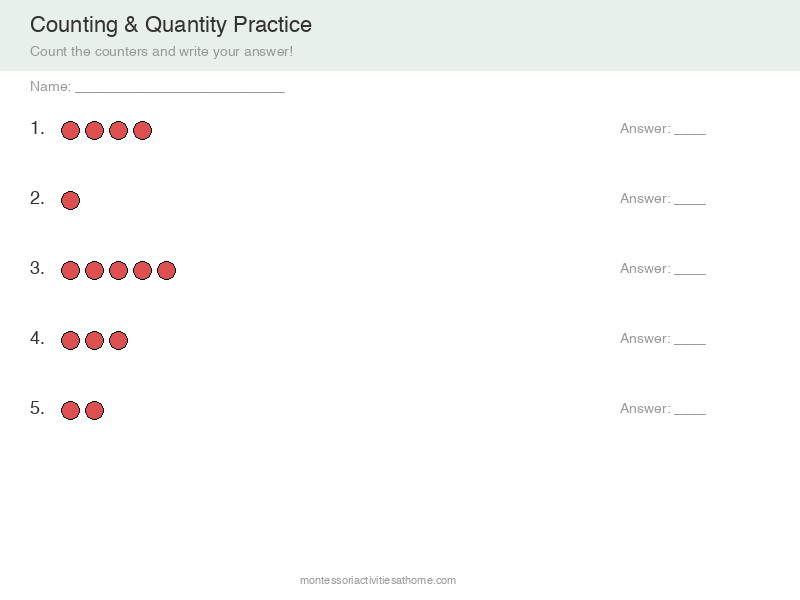
Start small. At two, the child puts one napkin at each seat. At three, they count out the forks. At four or five, they set the whole table and notice when someone is missing a spoon. When you want to move that idea onto paper, do it with quantities they have already handled.
Signs your child is ready for the next level
The table above tells you what comes next. These signs tell you when.
- They do the current skill without watching their hands. A child who pours while looking at you is done learning to pour.
- They finish and then wander off, or get silly. Repeating with focus means keep going. Repeating with giggles and deliberate spills means bored.
- They start adding steps on their own. Wiping the table and then, unprompted, carrying the cloth to the sink.
- They ask for the adult version. “Can I use the real knife?” is a readiness signal even when the answer is “not yet, but here is the next knife.”
- The tray stays untouched for a week. Not refusal, just indifference. Time to swap it.
One caveat: readiness is uneven across strands. A child can be at the 4–6 column in food prep and firmly at 2–3 in care of self. That is normal, and it is the reason a progression table is more useful than a single age label.
Common mistakes parents make with practical life
- Rescuing too soon. The child struggles with a button for eight seconds and a hand appears. Count to ten in your head before you move. The struggle is the learning.
- Tools that are too big. An adult broom, a full-size pitcher, a heavy watering can. If the child cannot control the tool, they cannot practice the skill; they are just wrestling.
- Expecting a finished product. A wiped table with streaks is a success. A table you re-wipe in front of the child teaches them their work does not count.
- Talking through the demonstration. Words compete with hands. Show first, name it later.
- Too many activities out at once. Three or four trays on a low shelf is plenty. A shelf of twelve gets ignored.
- Wrong time of day. Introducing a new skill at 5:45 pm to a hungry child fails for reasons that have nothing to do with the skill.
- Praising the product. “What a clean table!” shifts attention to your approval. “You did the whole thing yourself” keeps it on the effort.
A realistic weekly rotation plan for a working parent
Most practical life advice assumes someone is home all day with a shelf of beautiful trays. Most of us are not. The version that survives real life has two parts: a few daily anchors that are bolted onto routines you already do, and one weekend big work that gets the unhurried time a full cycle needs.
| Day | Routine you already have | Practical life version | Extra time |
|---|---|---|---|
| Monday | Getting dressed | Two outfit choices on a low shelf the night before; child dresses without help | +5 min |
| Tuesday | Breakfast | Child pours own milk from a small creamer and wipes drips with a cloth kept on the table | +3 min |
| Wednesday | After dinner | Child carries own plate to the counter and wipes their spot | +3 min |
| Thursday | Bath night | Child washes own arms and legs with a small cloth, dries with own towel from a low hook | +5 min |
| Friday | Snack | Child slices a banana or spreads crackers for everyone | +10 min |
| Saturday | Free morning | Big work: a full cycle such as table washing, a simple recipe, or watering every plant in the house | 20–30 min |
| Sunday | Weekly reset | Child helps sort laundry, refill the snack shelf, and choose which tray goes out this week | 15 min |
Once an anchor becomes automatic (the child pours their milk without being asked), it stops costing extra time and you can add another. Rotate the Saturday big work through the four strands so one month covers all of them.
Troubleshooting: when it isn’t working
My child refuses the activity
Do not push. Leave the tray on the shelf and do the task yourself nearby, slowly, without inviting them. Curiosity usually does the rest within a few days. If not, the skill may be a level too high; try again in two or three weeks. Refusal at 5 pm is not refusal, it is tiredness.
Everything ends in a mess
Mess is feedback, not misbehavior. Cut the quantity: a finger’s depth of water in the pitcher, six beans instead of a cupful. Use a tray with a raised edge. Include the cleanup cloth in the setup and the demonstration, so wiping up is part of the activity rather than a consequence.
They lose interest in 30 seconds
Three usual causes. Too easy: move up a row in the table. Too hard: the child cannot see a path to success and bails. Or too much talking and hovering from you. Present again with fewer words, then leave the room.
They want me to do it for them
Common after a new sibling, a move, or a bad night. Meet them partway: “I will hold the bowl; you pour.” Or do every step except the last and let them finish. Independence comes back; do not make it a standoff.
They do it “wrong”
If it is safe, let it stand. Correcting in the moment teaches the child to watch your face instead of their hands. Re-present another day, slowly, and let them notice the difference themselves.
Frequently Asked Questions
At what age should I start Montessori practical life activities?
Most families can start around 12 to 15 months, once a child walks steadily and can carry something in one hand. Before that, practical life is mostly about including the baby: a spoon to hold at meals, a cloth to wipe their own face, watching you work at their eye level. There is no age where it is too late to begin; you simply start further along the progression.
What are the four areas of Montessori practical life?
Care of self (dressing, washing, toileting, grooming), care of the environment (cleaning, tidying, plant and pet care), food preparation (pouring, cutting, spreading, cooking, setting the table), and grace and courtesy (greetings, manners, turn-taking, how to interrupt). Some Montessori guides list control of movement, like walking on a line or carrying a tray, as a fifth area.
Do I need to buy Montessori materials for practical life?
No. Practical life is the one Montessori area that needs almost nothing special. What matters is that the tools are child-sized and real: a small glass pitcher, a step stool, a few cloths, a small broom, a nylon knife. Most of it is already in your kitchen or costs a few dollars.
How long should a practical life activity take?
As long as the child stays engaged, and not a minute longer. At 18 months that may be two minutes; at four it may be twenty. Do not set a timer or push for one more round. The activity is finished when the child completes the cycle and returns the materials, or when they walk away.
What is the difference between practical life and chores?
A chore is assigned by the parent and judged by whether the job got done. Practical life is chosen by the child from a few prepared options, done with child-sized tools, and judged by nothing at all: the point is the skill and concentration the child builds, not the clean table. The same task, wiping a table, can be either depending on how you set it up.
Does practical life really prepare a child for writing and math?
Yes, indirectly, and that is by design. Pouring, spooning, squeezing and using tongs build the pincer grip and wrist control a pencil needs. Wiping a table left to right rehearses the direction of reading and writing. Setting the table for four people is one-to-one correspondence, the foundation of counting. By the time a child meets tracing sheets or counting worksheets, the hand and the idea are already there.
Print these next
When the hand is ready, these are the sheets that pick up where practical life leaves off:
- Pre-writing strokes — the first pencil work after a year of pouring and spooning.
- Straight-line letters — the easiest letters to trace, before curves.
- Counting 1–5 with apples — the paper version of setting the table.
- Number tracing 1–10 — once counting out forks is automatic.
- Activity Generator — tell it your child’s age and what is in your kitchen, and it suggests a practical life activity at the right level.