Number Bonds to 10 Worksheet
About This Worksheet
Number bonds are one of the most powerful tools in early mathematics education. A number bond is a simple diagram that shows how a whole number breaks apart into two smaller parts — and how those two parts come back together to form the whole. This worksheet focuses specifically on bonds that make 10, which is arguably the most important number relationship your child will learn in their first years of math.
Why is 10 so special? Our entire number system is built on groups of ten. When children understand intuitively that 7 + 3 = 10, or that 6 + 4 = 10, they unlock the ability to do mental arithmetic with remarkable speed. A child who knows their bonds to 10 can easily tackle problems like 7 + 5 by thinking "7 needs 3 more to make 10, and 5 has 2 left over, so the answer is 12." This strategy — called bridging through 10 — is exactly how confident mathematicians think.
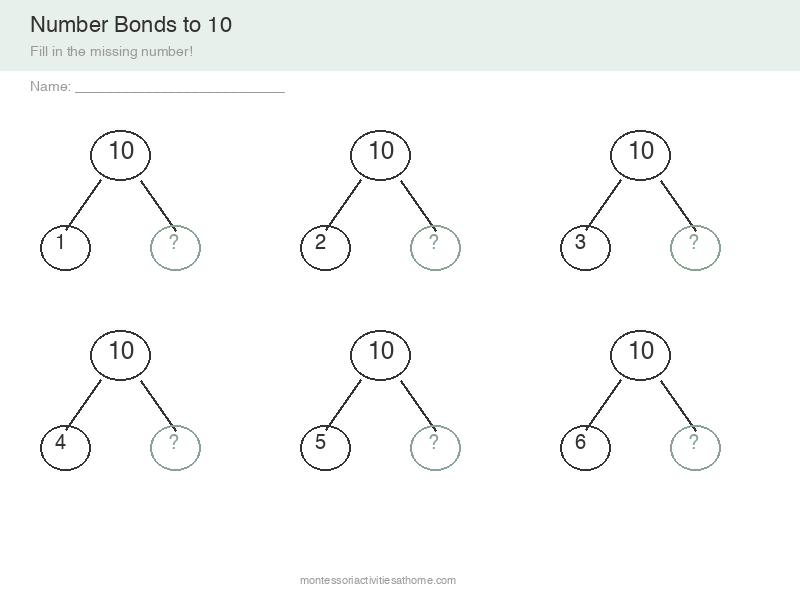
In Montessori classrooms, children explore number bonds using physical materials like bead bars and ten frames long before they encounter abstract symbols. This worksheet bridges that concrete experience with a visual representation, giving your child a gentle step toward written math. Each diagram presents a circle containing the number 10 connected by lines to two smaller circles. One of the smaller circles contains a number; your child fills in the missing partner. Through repetition, these pairs become automatic — stored in memory rather than calculated each time.
Skills Practiced
How to Use This Worksheet
- Start with manipulatives. Before picking up a pencil, give your child 10 small objects — beads, buttons, or dried beans. Ask them to split the group into two piles and count each pile. This concrete experience makes the worksheet meaningful rather than abstract.
- Read the bond together. Point to the whole number (10) and the given part. Ask your child, "If we have 10 altogether and this part is 3, how many are hiding in the other circle?" Let them use fingers or objects to figure it out.
- Write and say the pair aloud. Once your child fills in the missing number, have them say the complete bond: "3 and 7 make 10." Speaking the relationship reinforces it through an additional sensory channel.
- Look for patterns. After completing several bonds, ask your child if they notice anything. Many children discover that as one part gets bigger, the other gets smaller — an early encounter with the concept of inverse relationships that will serve them throughout their math education.