Free Printable Number Tracing Worksheets 1-10 (Ages 3-5)
About This Worksheet
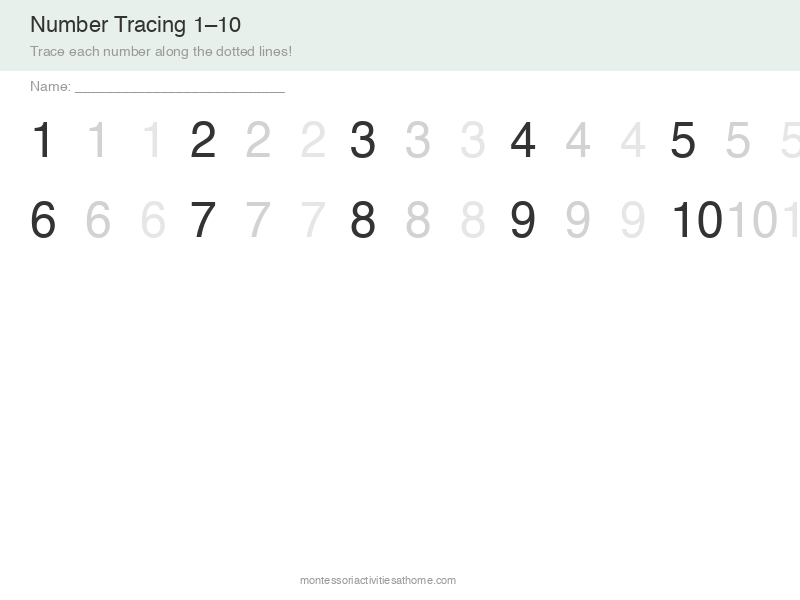
Writing numbers correctly is a skill that requires surprising coordination for young hands. This tracing worksheet breaks each numeral into guided strokes with dotted lines and directional arrows, showing your child exactly where to start and which direction to move. Each number gets its own row with multiple tracing opportunities, progressing from heavily guided to lighter guides.
In Montessori classrooms, children practice number formation in sand trays and with sandpaper numerals before moving to paper. This worksheet is designed for the paper stage — when your child already recognizes the numerals and has some experience forming them with their finger. If they have not yet traced numbers in sand or salt, try that first. The tactile, pressure-free experience makes the transition to pencil and paper much smoother.
Correct number formation matters because habits formed now persist. A child who learns to write “5” starting from the bottom will struggle to unlearn that pattern later. The directional arrows on this worksheet establish correct stroke order from the start, preventing the need for correction down the road.
Skills Practiced
How to Use This Worksheet
- Use a thick pencil or crayon. Standard pencils are too thin for most preschool hands. Triangular grip pencils or thick crayons are ideal because they naturally position the fingers correctly.
- Follow the arrows. Before tracing, run your finger along the arrows to show the path. Say the stroke directions aloud: “Down and across” for the number 4, “Around and down” for the number 6.
- Start with their favorites. If your child loves the number 3 (maybe it is their age), start there. Building confidence with a familiar number creates momentum for tackling harder ones like 8 or 5.
- Celebrate effort, not perfection. Wobbly lines and overshooting the path are completely normal. If a number looks roughly right, that is a success. Fine motor precision develops over months, not in one sitting.