The fastest way to help a first grader with subtraction is to print one sheet per strategy they’re being taught, not one big stack of mixed problems.
- Start with the Subtraction Within 20 worksheet: counters with the taken-away ones pre-crossed; your child counts what’s left.
- Six strategies matter in first grade: take-away with objects, counting back on a number line, number bonds, ten frames, subtraction within 20, and related addition facts.
- Every strategy has a free sheet plus a “make your own” recipe for the math worksheet generator (Subtraction, Within 10 or 20, 5 or 10 problems).
- One sheet a day, five to ten problems, counters within reach. Six fill-in-the-name word problems and a two-week plan are at the bottom.
This is for parents of first graders, roughly ages six and seven, who are meeting subtraction for the first time and want something to print tonight. It also works if you’re homeschooling and want to know what first-grade subtraction covers.
Most subtraction worksheet pages hand you a pile of look-alike sheets. This one follows the six strategies a first grader is actually taught, in roughly that order, with a matching sheet for each. When your child comes home saying “we did number bonds today,” you’ll know exactly which page to print. Everything prints free, no sign-up, and for fresh copies the math worksheet generator settings are listed under each strategy.
Three subtraction worksheets built for this guide
These three appear on no other page of the site. Between them they cover the progression most first-grade subtraction sets compress into one sheet: working under ten first, then counting back, then seeing subtraction and addition as the same fact.
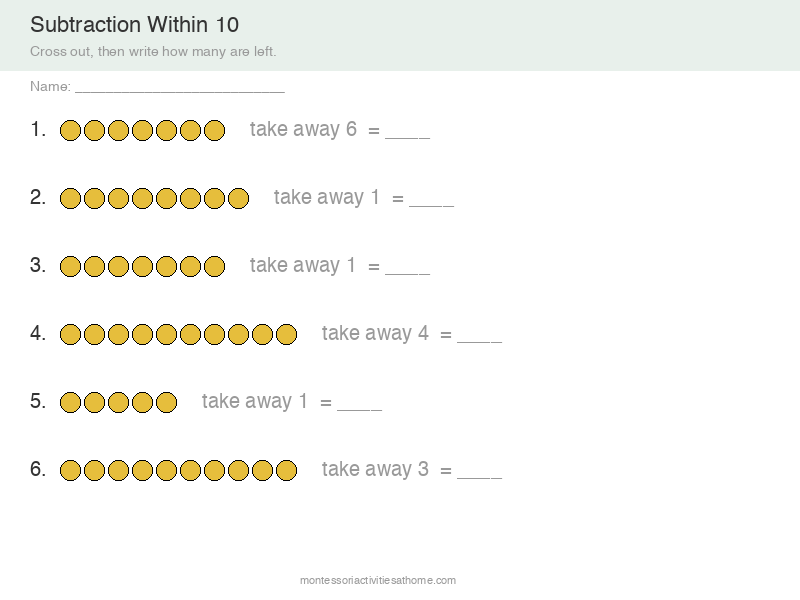
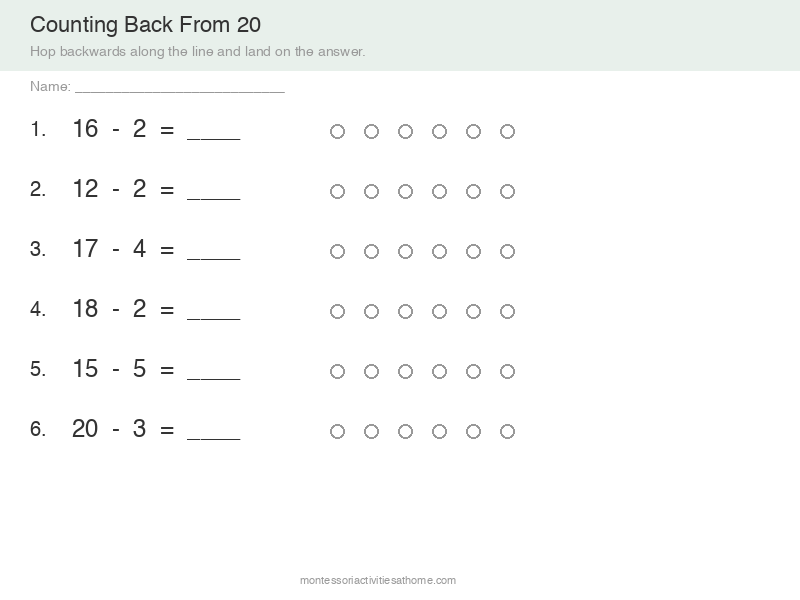
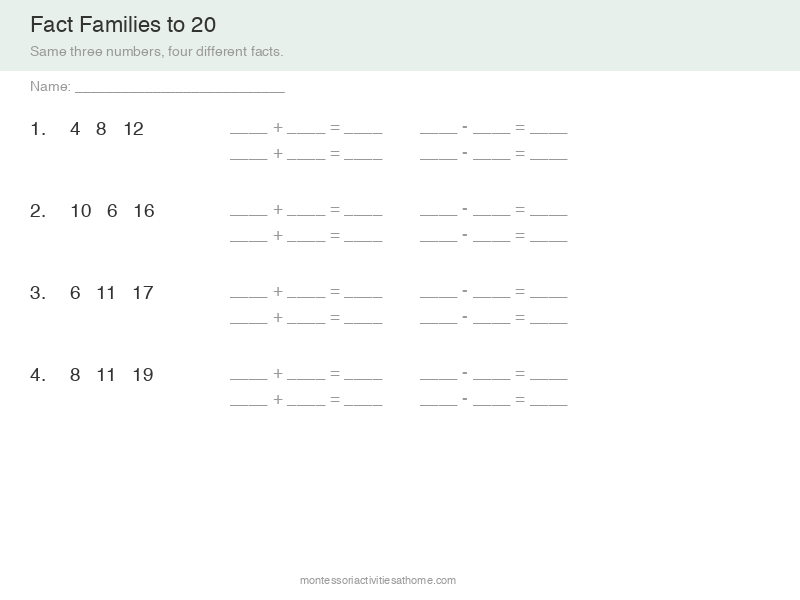
Work them in that order. A first grader who can do fact families understands subtraction; one who can only take away is still counting.
The main sheet: Subtraction Within 20
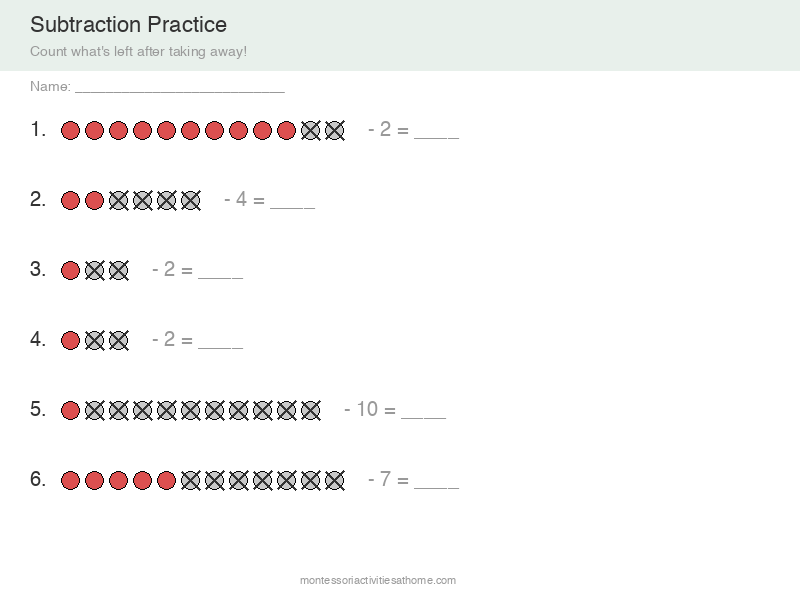
This is the one to print first. Each row shows a group of counters with the taken-away ones already crossed out, then a number sentence with a blank. Your child counts the whole row for the starting number, counts the plain counters for what’s left, and writes the answer.
Two things I like about this format. The crossing out is done for them, so a child still shaky at drawing neat Xs can focus on the math. And the starting number isn’t printed, so they have to count the full row first, which keeps “how many did we start with” in the picture, the step first graders most often skip.
Sit with them for the first row only and say it out loud: “Twelve, take away two, leaves ten.” Then step back. If they count the crossed-out counters too, have them cover the Xs with a finger.
Print the Subtraction Within 20 worksheet, or make your own: generator → Subtraction, Within 10 for the first week or Within 20 once ten is solid, 5 problems, and pick beads, apples, stars, or monkeys.
Why first graders find subtraction harder than addition
If your child sailed through addition and then stalled, that’s normal. There are plain reasons for it, and none of them mean your child is behind.
- Addition only has one meaning. Subtraction can mean taking away, comparing two groups, or finding a missing part, and each feels like a different job to a six-year-old.
- Counting backward is genuinely harder. Kids have chanted “1, 2, 3” since they were toddlers. “12, 11, 10” has had far less practice.
- The answer gets smaller. In addition the answer is the biggest number on the page. In subtraction it comes first, and children who quietly learned “the big number goes at the end” get tangled.
- Order matters. 3 + 5 and 5 + 3 are the same. 8 − 3 and 3 − 8 are not, and kids who happily swap numbers in addition keep swapping them here.
- There’s a number to hold in your head. With 9 − 4, the child keeps 9 in mind while doing something to it. That’s heavier than adding two groups they can see.
Subtraction simply needs its own set of tools. Those are the six strategies.
The 6 subtraction strategies first graders learn (with a sheet for each)
1. Take away with objects (crossing out)
The first strategy is the most physical one: start with a group, remove some, count what’s left. On paper, that becomes crossing out.
Our counting sheets work in reverse for this. Take the Count 1 to 10 with Stars sheet: each row is a plain line of counters and an answer blank. Instead of “count these,” you say “cross out three.” Your child draws the Xs, counts the survivors, and writes the answer. Because they made the Xs, they own the taking away.
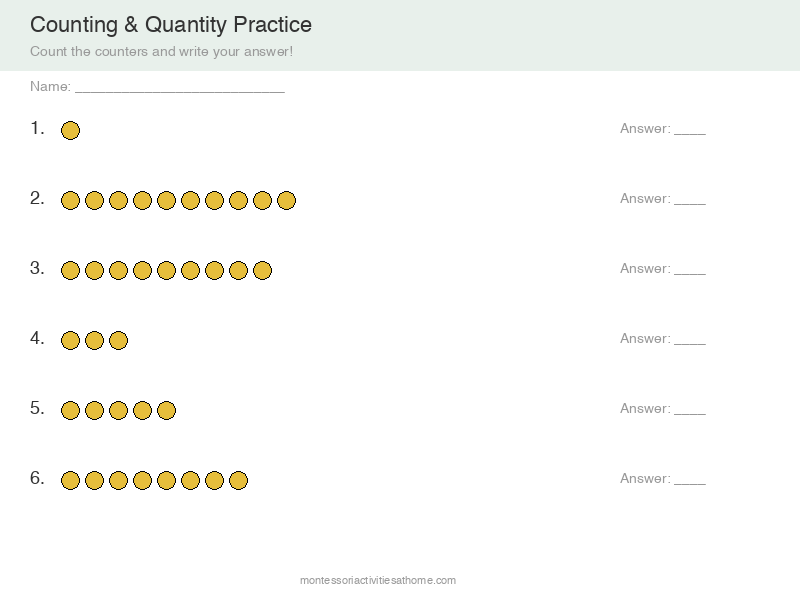
Write a small number next to each row before you hand it over (“−3”, “−1”, “−4”) and tell a story on the first one: “Seven stars in the sky. Three fell down. How many are still up?” Tapping each crossed-out star and saying “gone” helps the child who wants to count everything.
Make your own: in the generator choose Counting & Quantity, 1 to 10, 10 problems, and write the minus numbers in the margin. Or choose Subtraction, Within 10, where the crossing out is printed for you.
2. Counting back on a number line
Once take-away makes sense, first graders learn to count back: start at 9, hop back 4, land on 5. This is the strategy that later turns into mental math, so it’s worth a few days on its own.
We don’t have a dedicated number-line sheet, but the Number Tracing 1–20 page makes a good one. Trace the numbers first (a warm-up kids usually enjoy), then use the traced row as the line: finger or small toy on the starting number, hop left one number at a time, saying each one out loud.
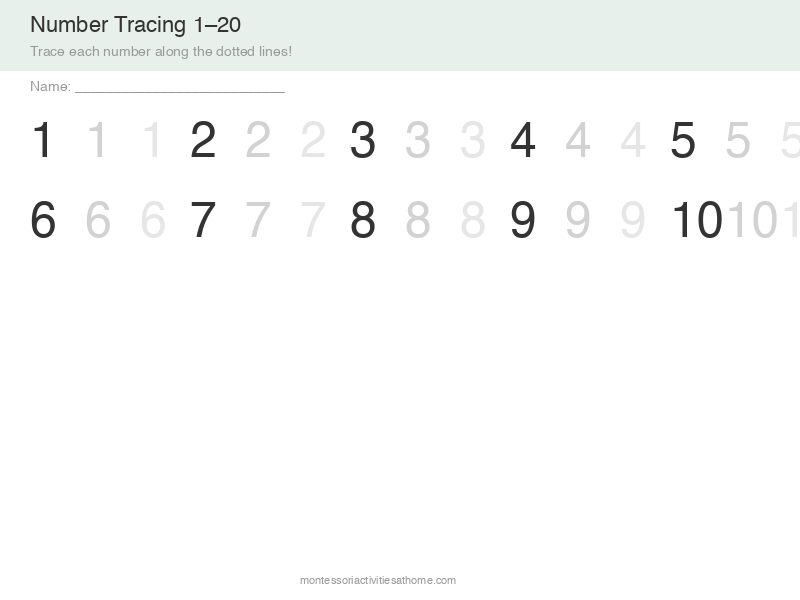
The mistake to watch for: counting the number you’re standing on as the first hop, so 9 − 4 becomes “9, 8, 7, 6.” Fix it with language: “You’re standing on 9. Hops are the ones you land on.” Then hop together: “8, 7, 6, 5.”
Keep the hops small. Counting back 1, 2, or 3 is efficient. Counting back 7 is slow and error-prone, and that’s the moment to move on to number bonds.
Make your own: print a Subtraction, Within 20, 5 problems sheet from the generator and solve each row on the number line instead of by counting counters.
📬 Never hunt for printables again
Join the free list and get new worksheets, coloring pages, and activity ideas in your inbox — free, printable, kid-tested.
No spam, unsubscribe anytime.
3. Number bonds and fact families
A number bond is a whole and its two parts: 10 splits into 6 and 4. Subtraction is the missing part. If your child knows 6 and 4 make 10, then 10 − 6 isn’t a calculation, it’s a fact they already have.
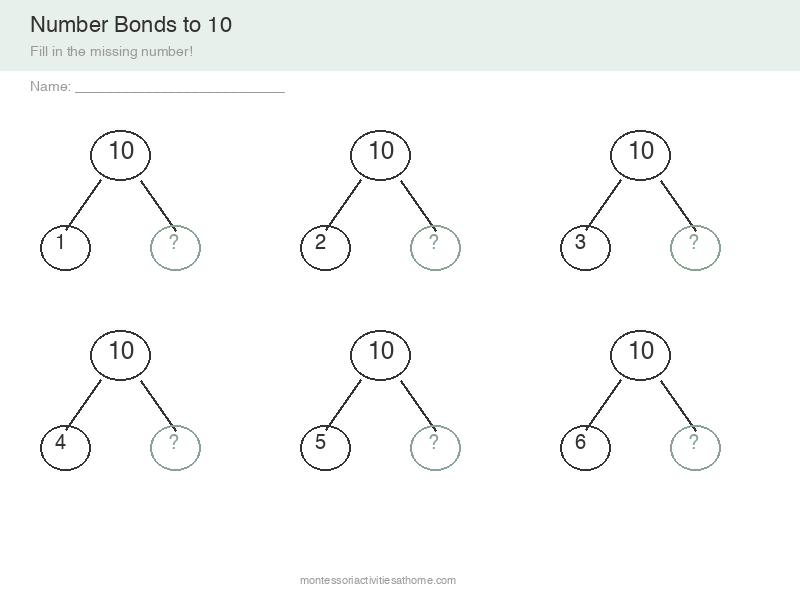
The Number Bonds to 10 sheet shows the whole (10) on top and one part below, with the other part missing. Say each bond two ways: “6 and what make 10?” then “10 take away 6 is what?” Same picture, two sentences. The child hears that addition and subtraction live in the same bond.
Then turn one bond into a fact family. Pick 10, 7, and 3 and write the four sentences under it: 7 + 3 = 10, 3 + 7 = 10, 10 − 7 = 3, 10 − 3 = 7. One family a day, not the whole page.
Make your own: the generator doesn’t draw bond diagrams, but a Subtraction, Within 10 sheet is ten ready-made bonds. Have your child write the addition partner beside each row.
4. Ten frames for subtracting from 10
A ten frame is a two-by-five grid. Fill in some dots and the empty boxes show the other part of 10 without counting. It’s the quickest way to see 10 − 4 = 6: four dots filled, six boxes empty.
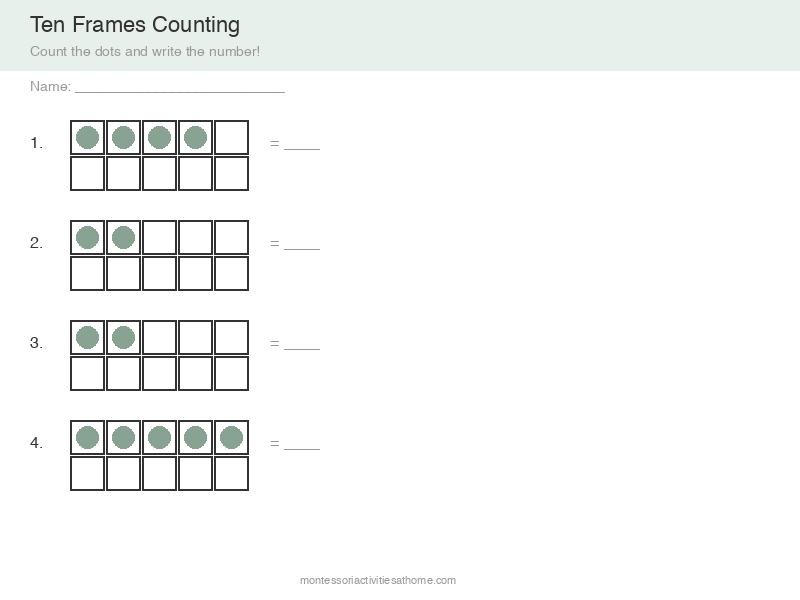
Our Ten Frames Counting sheet is written as a counting page, so use it in reverse, same trick as the stars. For each frame ask “How many dots?” then “How many empty?” and write the sentence beside it: 10 − 4 = 6. After a few days the child stops counting the empty boxes and just knows. Subtracting across ten (15 − 7) builds on this later, but that’s a second-grade job.
Make your own: draw two rows of five boxes on an index card and use dried beans as dots.
5. Subtraction within 20
This is the end-of-year target: problems like 14 − 6 and 17 − 9, solved with a strategy rather than a guess. It’s the level the Subtraction Within 20 worksheet at the top is built for.
Don’t start here. In our house the order that worked was crossing out within 10 until it was easy, counting back for small hops, bonds to 10 until they were quick, and only then the within-20 sheet. If the long rows (up to 20 counters) make them lose count halfway, drop back to Within 10 for a week.
How to tell it’s clicking: they stop counting from one. A child who sees 15 counters with 5 crossed out and says “that’s 10 left” without touching each one is using the ten-frame picture in their head.
Make your own: generator → Subtraction, Within 20, 10 problems. Change the picture type each time (stars one day, monkeys the next).
6. Related addition and subtraction facts
The last strategy ties everything together: every subtraction fact has an addition partner. 13 − 5 = 8 because 8 + 5 = 13. First graders who see this can lean on their (usually stronger) addition facts.
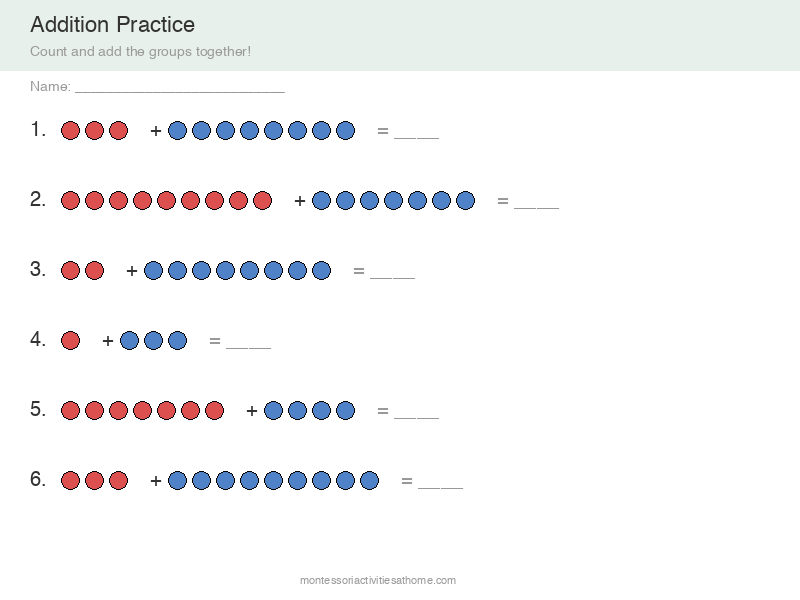
Print the Addition Within 20 sheet and the subtraction sheet on the same day. Do one addition row, then ask: “What subtraction sentence is hiding in this picture?” Three red and seven blue make ten; take away the red and seven blue are left. Then flip it: a subtraction row, and ask for its addition partner.
“Think addition” is what most adults do without noticing. For 12 − 7, you don’t count back seven. You ask “7 and what make 12?” Have your child say it out loud on every problem for a week.
Make your own: an Addition, Up to 20 sheet and a Subtraction, Within 20 sheet, same picture type, stapled together.
Strategy cheat sheet: what to print for each one
| Strategy | What it looks like | Worksheet to print | Common mistake |
|---|---|---|---|
| 1. Take away with objects | Row of counters; child crosses some out, counts the rest | Count 1 to 10 with Stars (in reverse) or Subtraction Within 20 | Counting the crossed-out counters too |
| 2. Counting back on a number line | Finger on the big number, hops left | Number Tracing 1–20 as a number line | Counting the start number as a hop (9 − 4 = 6) |
| 3. Number bonds / fact families | Whole on top, one part missing | Number Bonds to 10 | Adding the two visible numbers |
| 4. Ten frames | 2×5 grid; empty boxes are the answer | Ten Frames Counting (in reverse) | Counting dots when asked for empties |
| 5. Subtraction within 20 | Long rows, taken-away counters pre-crossed | Subtraction Within 20 | Losing count on long rows; swapping numbers (3 − 8) |
| 6. Related addition facts | Addition and subtraction sheets side by side | Addition Within 20 + Subtraction Within 20 | Parts in the wrong slots (10 + 3 = 7) |
Subtraction word problems: 6 templates you can fill in with your child’s name
Word problems show whether the sheets are working. Keep the numbers within 20, use your child’s name and their actual stuff, and let them draw the picture before writing the sentence. Fill in the brackets.
- Take away: “[Name] had [12] [grapes]. [Name] ate [5]. How many [grapes] are left?”
- Something leaves: “There were [9] [birds] on the fence. [4] flew away. How many [birds] are still on the fence?”
- Compare, how many more: “[Name] has [11] [stickers]. [Friend] has [7]. How many more [stickers] does [Name] have?”
- Compare, how many fewer: “[Name] built a tower of [15] blocks. [Friend]’s tower has [8]. How many fewer blocks does [Friend]’s tower have?”
- Missing part: “[Name] needs [10] [shells] for a collection and has found [6]. How many more [shells] does [Name] need?”
- What did we start with (the hard one): “[Name] gave [3] [crackers] to the dog and has [7] left. How many [crackers] did [Name] start with?”
Do 1 and 2 first, because taking away is the meaning they already have. Add 3 and 4 after number bonds, and save 5 and 6 for week two. Number 6 is an addition problem in disguise, and noticing that on their own is a big moment for a six-year-old.
A tip that has saved us tears: before they touch a pencil, ask “Is the answer going to be bigger or smaller than [12]?” If they say “bigger” on a take-away problem, you’ve caught the confusion before it becomes a wrong answer.
A 2-week subtraction practice plan
Ten minutes a day, five to ten problems, counters on the table even when they don’t use them. If a day goes badly, repeat it instead of moving on.
| Day | Strategy | What to print or do |
|---|---|---|
| 1 | Take away with objects | Ten counters on a plate, five take-away stories, no paper yet |
| 2 | Take away with objects | Count 1 to 10 with Stars; you write the minus numbers, they cross out |
| 3 | Take away with objects | Subtraction Within 20, or generator: Subtraction, Within 10, 5 problems |
| 4 | Counting back | Trace Number Tracing 1–20, then hop back for five problems (subtract 1, 2, or 3) |
| 5 | Counting back + word problems | Five number-line problems, then templates 1 and 2 |
| 6 | Number bonds | Number Bonds to 10; say each bond both ways |
| 7 | Fact families | Pick two bonds from Day 6 and write the four sentences for each |
| 8 | Ten frames | Ten Frames Counting in reverse: dots, empties, write 10 − __ = __ |
| 9 | Within 20 | Generator: Subtraction, Within 20, 10 problems, new picture type |
| 10 | Related facts + word problems | Addition Within 20 next to Subtraction Within 20; templates 3 through 6 |
After that, one Within 20 sheet a couple of times a week, a new picture type each time, and the question “what’s the addition partner?” is enough to keep the facts from fading.
Frequently Asked Questions
What subtraction should a first grader know by the end of the year?
Most first-grade programs aim for subtraction within 20 using strategies (counting back, number bonds, related addition facts), with quick recall of facts within 10. Fast fluency within 20 usually comes in second grade. If your child can solve 14 − 6 with a strategy and explain how they did it, they’re where they should be.
Should first graders use their fingers or counters for subtraction?
Yes. Counters, fingers, and crossed-out pictures are strategies, not crutches. Children drop them on their own once the facts are secure. Taking the tools away early usually produces guessing, not speed.
How many subtraction problems should a first grader do a day?
Five to ten problems, done thoughtfully, beat a full page. Ten minutes is plenty. Stop while it’s still going well; the sheet is for practice, not a test.
Why does my child keep swapping the numbers, like solving 3 − 8 as 5?
In addition the order never mattered, so children carry that habit into subtraction. Go back to counters and ask them to take 8 away from 3. Physically trying and failing teaches more than an explanation.
Are these subtraction worksheets really free?
Yes. Every worksheet linked in this post prints free with no sign-up. The math worksheet generator has a free tier for custom sheets; full access to everything on the site is $9 a month or $79 a year, but nothing in this post requires it.
Print these next
In the order the plan uses them:
- Subtraction Within 20 — the main sheet.
- Count 1 to 10 with Stars — in reverse, for crossing out.
- Number Bonds to 10 — the missing part is the answer.
- Ten Frames Counting — subtracting from 10 at a glance.
- Addition Within 20 — the partner sheet for related facts.
- Math worksheet generator — Subtraction, Within 10 or 20, 5 or 10 problems, your child’s favorite picture.
The full math worksheet gallery has counting, patterns, and shapes sheets too. For hands-on first-grade math, see 20 Montessori activities for 6-year-olds; for a step back, the kindergarten addition worksheets.