Match the coloring page to the hand, not the age on the birthday cake: big open shapes and chunky crayons at 2–3, medium-detail single subjects and triangular crayons at 4–5, busy scenes and colored pencils at 6–8, mandalas and fine-tip pencils at 8–12.
- Montessori herself was skeptical of coloring-in. Used deliberately (child’s choice, no correcting, blank paper nearby) it still earns a place at home.
- What makes or breaks a page: line thickness and how much detail sits inside each shape.
- Crayons before pencils. Toddlers need the resistance; pencils come once a three-finger grip shows up on its own.
- A page does not have to be finished. A half-colored page did the same hand work.
- Want to print right now? All 69 pages are in the free Montessori coloring pages library, sorted by subject.
- If your kid wants a page nobody has drawn yet, the free coloring page generator makes it from a sentence.
Every parenting site has a “benefits of coloring” article. This is not one of those. This is the page I wish I had found when I was standing at the printer wondering why my two-year-old shredded a detailed jungle scene in thirty seconds while his older sister sat with a simple butterfly and got bored.
I had the pages backwards. The toddler needed the butterfly and the six-year-old needed the jungle. Obvious written down; not obvious at 4 p.m. with two kids asking for “the dinosaur one.”
So this is a practical guide: what a child’s hand can do at each age, which kind of page fits that hand, which crayon or pencil to put next to it, and which of the 69 free pages on this site to print. Plus the honest Montessori view, which is more complicated than “Montessori hates coloring books.”
Is coloring Montessori? The honest answer
Not really, if you go by the source. Maria Montessori was openly skeptical of handing children an adult’s drawing to fill in. Her view was that the child should produce, not reproduce. In a Montessori classroom you find the metal insets (geometric shapes a child traces and fills with parallel pencil lines), free drawing, painting, and clay. You rarely find a photocopied cartoon.
Her objection was not to the crayon. It was to the idea that a child’s job is to color inside someone else’s lines and be praised for neatness. Which is exactly how most coloring pages get used: a quiet-time filler, with a “good job staying in the lines” at the end.
Here is the case for using them anyway, on purpose. The metal insets exist because the hand needs pencil practice before it can write, and that practice should be something the child wants to do. A well-chosen coloring page does the same job with a subject the child picked. Keep the principles that matter (process over product, real tools, the child’s choice, no correcting) and drop the idea that the finished page is the point.
The rule in our house: coloring pages live on the same tray as blank paper. The child picks. Nobody says “the sky isn’t green.” Nobody tells them to finish.
Coloring pages by age: what to print and why
Ages are rough. A four-year-old who has drawn daily since two may be ready for the six-to-eight pages; a six-year-old who has rarely held a pencil may need the four-to-five ones for a while. Watch the hand, not the birthday.
Ages 2–3: one big shape, thick lines, crayons that need pressure
What the hand can do: a whole-fist grip, movement from the shoulder, big arcs and back-and-forth scribbles. Fingers do not yet move independently. Stopping at a line is not physically possible, so a page with fine detail is just a page with clutter on it.
What kind of page fits: one large subject with wide-open areas and lines thick enough that a scribble crossing them still looks fine. The rainbow below is close to ideal: seven wide bands, a sun, two birds, a hill, all in heavy outlines.
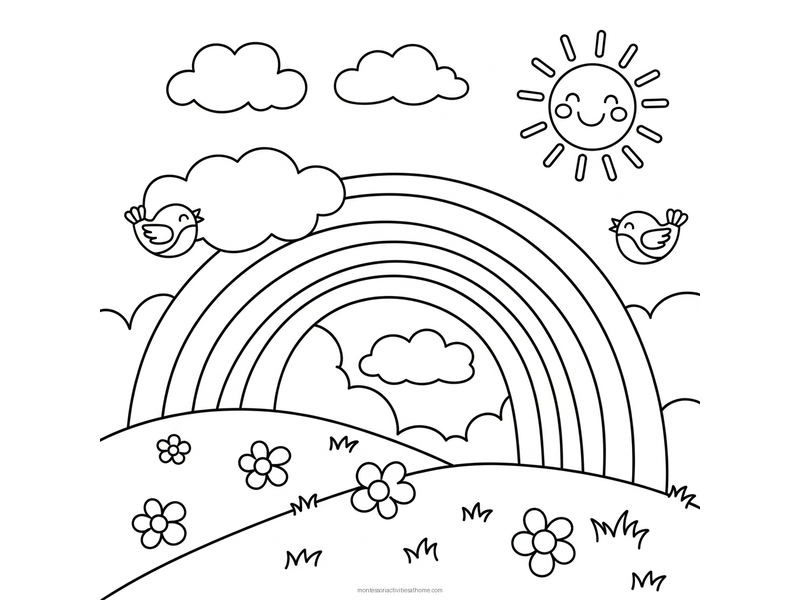
Pages on this site that fit: the rainbow, the kitten (one big cat, one big window), the pumpkin, and the penguin. Skip anything with a busy background.
Tools: chunky crayons, egg-shaped crayons, or ordinary crayons snapped in half. Broken crayons are the Montessori trick: too short to fist-grip comfortably, so fingers take over. Crayons over markers at this age. A marker slides with no effort, and effort is what builds the hand.
How long a sitting lasts: until it doesn’t. Toddlers color the way they eat: intensely, briefly, then they are done and want to show you. Do not stretch it. Put the tray back and let them return to it later, which they often do.
Ages 4–5: one subject with parts to it, triangular crayons or thick pencils
What the hand can do: some version of a three-finger grip appears, the wrist joins in, and the child can slow down at a line even if they cannot stop at it. They start choosing colors on purpose, and start caring how it looks, which is new and worth handling gently.
What kind of page fits: a recognizable subject made of several medium-sized parts: a truck with wheels, a cab, a ladder, a garage. Enough sections for color decisions, none so small they need pencil-point precision. The fire truck below has about a dozen distinct areas, which is right.
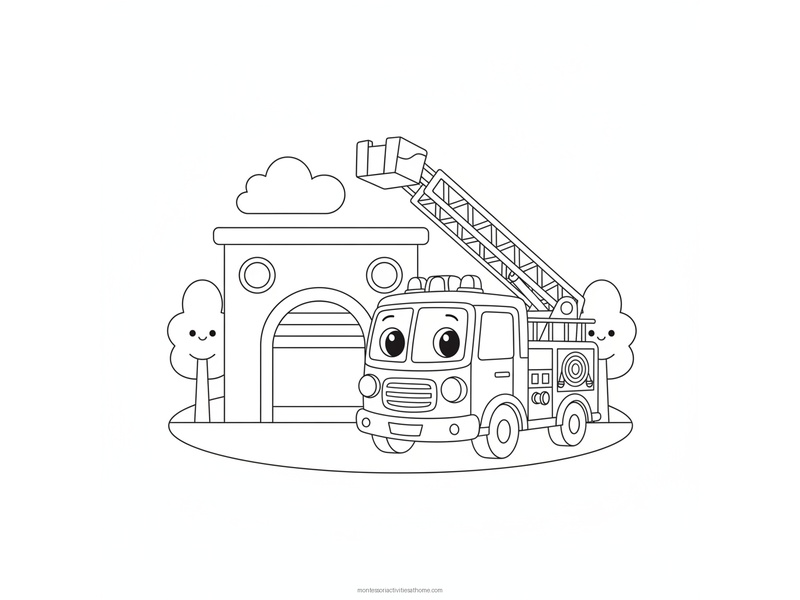
Pages on this site that fit: the fire truck, the construction truck, the train, farm animals, the dinosaur, the puppy, and the race car.
Tools: triangular crayons or chunky triangular colored pencils. The three flat sides nudge the fingers into a tripod grip without anyone saying a word about grip. A small pencil sharpener becomes its own activity at this age.
How long a sitting lasts: long enough to finish one subject, on a good day. Other days they color the wheels and wander off. Both are fine. A child who keeps abandoning pages halfway is usually telling you the page is too detailed for their hand, not that they are “not into coloring.”
📬 Never hunt for printables again
Join the free list and get new worksheets, coloring pages, and activity ideas in your inbox — free, printable, kid-tested.
No spam, unsubscribe anytime.
Ages 6–8: full scenes, small areas, regular colored pencils
What the hand can do: a settled tripod grip, finger movement independent of the wrist, real control of pressure. This is when “staying in the lines” happens by itself, because the hand finally can. Kids start shading, layering colors, and planning: “the water is going to be three different blues.”
What kind of page fits: a whole scene with foreground, background, and many small separate areas. The underwater scene below: five fish, a turtle with a segmented shell, coral, bubbles, seaweed, sand, wave lines. Each is a small decision, and there are dozens.
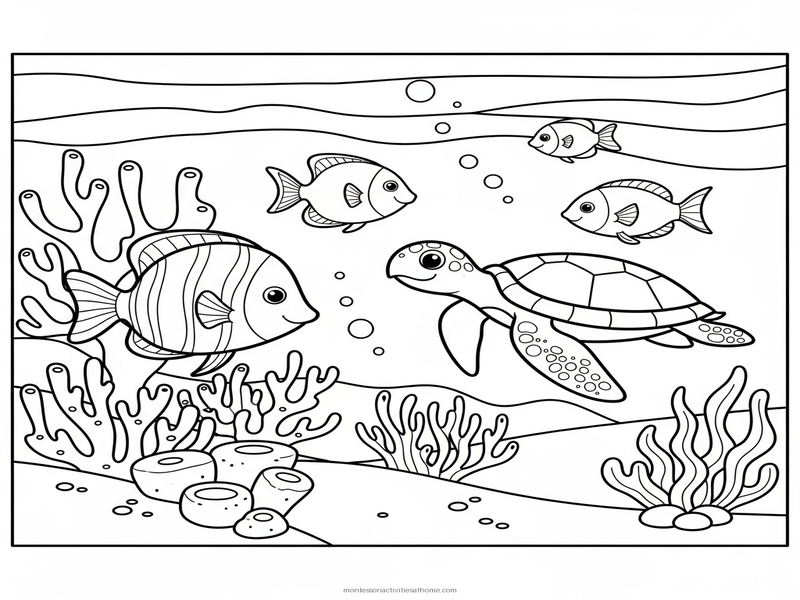
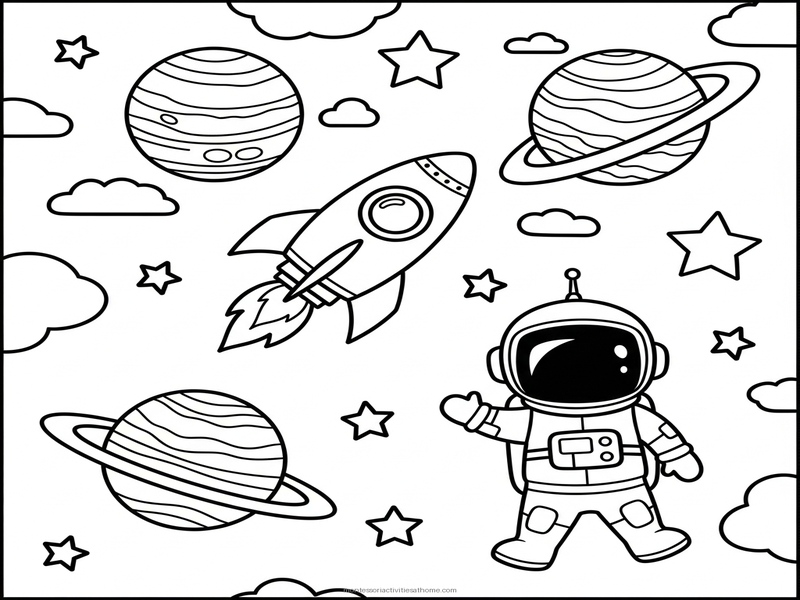
Pages on this site that fit: the underwater scene, outer space, jungle animals, the mermaid, the shark, the unicorn, and the multi-dinosaur dinosaurs page.
Tools: a proper set of colored pencils, kept sharp, in a cup or roll rather than a box lid they dig through. Cheap pencils with crumbly leads frustrate a child who can finally control them. Fine markers work for outlines now. Crayons start to feel babyish to many kids at this age, fairly; their hand has outgrown them.
How long a sitting lasts: this is the age of the long sit. A scene like these can hold a child through a quiet afternoon, or get picked up over several days. Leave it out. A half-finished page on the table is an invitation.
Ages 8–12: mandalas and patterned animals, fine-tip pencils
What the hand can do: nearly everything an adult hand can. The limit is no longer control, it is patience and interest. A page for this age has to feel like a craft, not something with cartoon eyes that came from a preschool.
What kind of page fits: mandalas and animals drawn as pattern. The owl below has feathers as layered leaf shapes, a patterned forehead, ringed eyes, veined leaves on the branch. Hundreds of tiny areas, which is the point. Nobody finishes it in one go, and older kids like that.
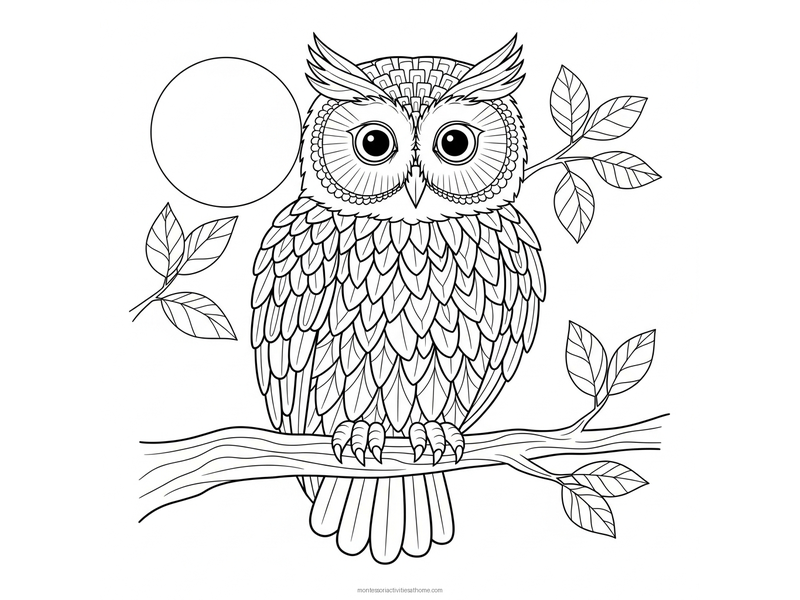
Pages on this site that fit: the mandalas (owl, flower, butterfly, elephant, unicorn) and the patterned animals: peacock, dragon, wolf, horse, and sea turtle.
Tools: fine-tip colored pencils, gel pens, or fine-line markers. A limited palette on purpose (“only blues and greens”) is a design decision, and a good one. A white eraser and a sharpener that catches shavings make it feel like real art supplies, which matters to this age more than any pep talk.
How long a sitting lasts: as long as an audiobook chapter or a car ride. Mandalas are the one kind of coloring page older kids reliably ask for again, usually when they want something for their hands while their mind is elsewhere.
The whole progression in one table
| Age | What the hand can do | Page type | Tools | Pages to print |
|---|---|---|---|---|
| 2–3 | Fist grip, movement from the shoulder, big scribbles, cannot stop at a line | One large subject, thick outlines, wide open areas | Chunky, egg-shaped, or snapped-in-half crayons | Rainbow, Kitten, Pumpkin, Penguin |
| 4–5 | Early three-finger grip, wrist joins in, slows down at lines, picks colors on purpose | One subject with a dozen or so medium parts | Triangular crayons, chunky triangular pencils, a small sharpener | Fire Truck, Farm Animals, Dinosaur, Construction Truck, Train |
| 6–8 | Settled tripod grip, independent finger movement, controls pressure, stays in lines by itself | Full scenes with background and many small areas | A real set of colored pencils, kept sharp; fine markers for outlines | Underwater Scene, Outer Space, Jungle Animals, Mermaid |
| 8–12 | Adult-level control; the limit is patience and interest, not the hand | Mandalas and animals drawn as pattern, no cartoon faces | Fine-tip pencils, gel pens, fine-line markers, a white eraser | Owl Mandala, Flower Mandala, Peacock, Dragon, Sea Turtle |
What coloring actually does for a child, briefly and honestly
You will read big claims about coloring. Here is the short, defensible list.
- Hand preparation for writing. The real one. Grip, pressure control, and the fine finger movement needed to stop at a line are the same movements handwriting needs. Occupational therapists commonly recommend coloring for this reason, and it is why the metal insets exist in a Montessori classroom.
- Sustained attention. A child who chose the page and likes the subject stays with it longer than almost any other seated activity. You cannot make that happen, but you can stop interrupting it.
- Calm. Repetitive hand movement with a visible result settles a lot of kids (and adults). In our house a mandala page comes out after a rough afternoon, not as punishment or reward, just as a way back to level.
- Color words and color decisions. A child coloring an underwater scene decides what color coral is and how many blues make water. That is vocabulary and judgment, without a lesson.
What coloring pages do not do: teach drawing, replace free art, or make a child creative. They train control. Creativity comes from the blank sheet next to them.
How to present coloring the Montessori way
The page matters less than the setup. These habits turn a printout into something closer to a Montessori material.
- A tray, not a pile. Two or three pages, the tools for that age, and blank paper on one tray on a low shelf. The child carries it to the table and puts it back. That is the whole activity, tidying included.
- Limited choice. Three pages beats thirty. A child faced with a binder flips through and picks nothing. Rotate the tray every week or two.
- Real tools, kept in good shape. Sharp pencils, a sharpener that works. A four-year-old cannot do good work with a stub, and will conclude they are bad at coloring rather than that the pencil is.
- Show once, then leave. If a child has never colored, slowly color one small area yourself, without narrating. Hand over the pencil and do something else in the same room. Hovering turns coloring into a performance.
- No correcting, no praise for neatness. Not “stay in the lines,” not “good job staying in the lines.” Both say the lines are the point. If you want to say something, describe: “you used four different greens on that turtle.”
- Finishing is optional. An abandoned page still did the hand work. Leave it on the tray; it often gets picked up days later.
- Print two. Doing a favorite page a second time is how a child notices their own improvement, and it costs one sheet of paper.
When coloring pages are the wrong choice
Sometimes the right move is to not print anything.
When the child wants to draw. If your kid pushes the page aside and starts drawing on the back, let them. That is the better activity, and the one Montessori would have chosen. The coloring page did its job by getting the crayons out.
When it has become a screen substitute. A page handed over to keep a child quiet, every day, with no choice involved, is not far from a tablet. The Montessori version has choice in it: the child picks the page, or picks not to.
When the hand is not ready. A child under two, or a toddler who still mouths crayons, gets more from finger painting, playdough, and the hand-strengthening work in our sensory activities for toddlers. Coloring can wait.
When it is always the same page. A child who will only color trucks has not run out of interest in coloring. They have run out of trucks.
The page your kid actually wants probably does not exist yet
The 69 free pages in the coloring gallery cover the obvious requests: dinosaurs, space, trucks, kittens, mermaids, mandalas. They do not cover “a T-rex driving a tractor,” which is the kind of thing a five-year-old asks for with total confidence at breakfast.
That is what the coloring page generator is for. Your kid names the subject, you type it in (“a T-rex driving a tractor on a farm”), and it draws a clean black-and-white page you can print in about twenty seconds, free. Two tips from using it at home:
- Say the age in the prompt. “For a 3 year old, thick lines, simple” and “detailed, for a 9 year old” produce very different pages of the same subject. Everything above about line thickness and detail applies to what you ask for.
- Let the child do the asking. A page the child described is a page the child chose, which is the Montessori part. It is also the page they sit with longest.
Frequently Asked Questions
What age can a child start using coloring pages?
Most children can start around age two, once they are reliably making marks on paper and have stopped putting crayons in their mouth. At that age the page is really just paper with a big shape on it. Offer chunky crayons, expect scribbles that ignore the lines completely, and treat that as a success.
Are coloring pages Montessori?
Not in the strict sense. Maria Montessori was skeptical of having children fill in adult drawings and preferred free drawing plus the metal insets for pencil control. Many Montessori homes still use coloring pages deliberately: chosen by the child, offered alongside blank paper, with no correcting and no praise for staying in the lines.
Should I make my child stay inside the lines?
No. Staying inside the lines happens on its own as hand control improves, usually somewhere between four and six. Correcting it earlier teaches a child that coloring is about pleasing you. If the page is too fiddly for their hand, print a simpler one instead of coaching.
Crayons, colored pencils, or markers: which is best for a preschooler?
Crayons for toddlers, because they need pressure and build hand strength. Triangular crayons or chunky triangular pencils around four to five, because the shape nudges a three-finger grip. Regular colored pencils from about six. Markers glide too easily to build strength, so keep them as an occasional treat rather than the default.
My 8-year-old says coloring pages are for babies. What now?
They are probably right about the pages they have seen. Offer a detailed mandala or patterned animal page and a set of sharp pencils, and do it without a pitch. Detailed pages read as a craft, not a preschool activity, and many older kids pick them up on their own when they want something quiet to do.
Print these next
One page per age band to start, all free, no sign-up:
- Rainbow Coloring Page for a 2–3 year old
- Fire Truck Coloring Page for a 4–5 year old
- Underwater Scene Coloring Page for a 6–8 year old
- Owl Mandala Coloring Page for an 8–12 year old
- Anything else your kid can describe: the free coloring page generator
Once the hand is steady on a coloring page, the next step is usually tracing: see our letter tracing guide.