Butterfly Coloring Page
About This Coloring Page
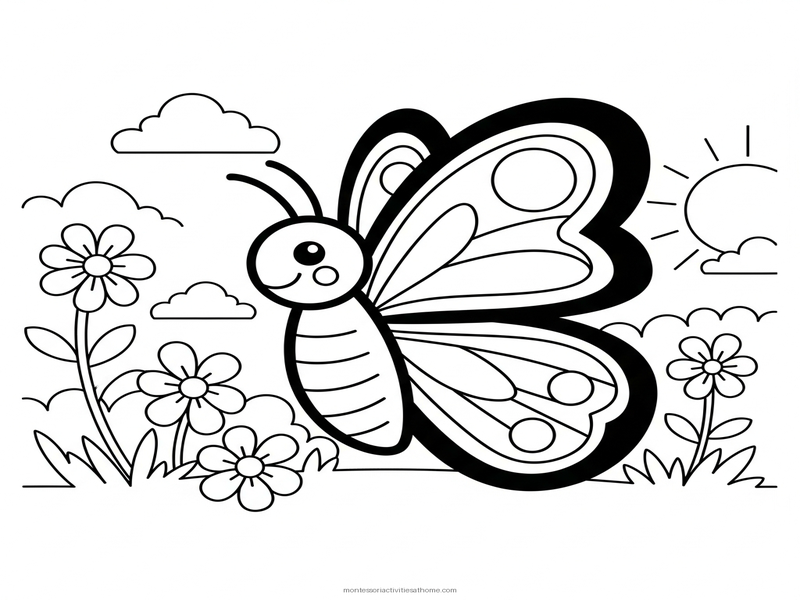
Butterflies are among the most captivating creatures in nature, and children are drawn to them instinctively. Their vivid colors, graceful flight, and astonishing transformation from caterpillar to winged insect make them a perfect subject for early learning. This coloring page features a large, detailed butterfly with clearly defined wing sections, inviting your child to explore color, pattern, and one of nature's most beautiful examples of symmetry.
Symmetry is a mathematical concept that children can grasp long before they learn the word. When your child colors one wing of a butterfly and then tries to match the other wing, they are practicing bilateral symmetry — the idea that a shape can be divided into two mirror-image halves. This concept appears throughout Montessori materials, from the geometric cabinet to the binomial cube, and encountering it through art gives children an intuitive foundation that deepens over time.
Beyond symmetry, coloring a butterfly opens a doorway to the natural world. You can talk about the butterfly life cycle — egg, caterpillar, chrysalis, butterfly — one of the most remarkable transformations in the animal kingdom. Discuss which butterflies live in your area, what flowers they visit, and why their bright colors sometimes serve as warnings to predators. In Montessori education, these connections between art and science are not distractions from the activity; they are the whole point. Every coloring session is an opportunity to nurture curiosity about the living world.
Skills Practiced
How to Use This Coloring Page
- Observe a real butterfly first. If possible, look at butterfly photographs or visit a butterfly garden before coloring. When children have a real reference, their coloring becomes more intentional and observational rather than purely decorative. Even a quick image search on your phone gives them real-world colors and patterns to draw from.
- Discuss the wings before coloring. Point out the line of symmetry down the butterfly's body. Explain that in nature, both wings have the same pattern. Challenge your child to color the left wing first, then try to make the right wing match. Younger children may not achieve a perfect mirror image, and that is absolutely fine — the attempt itself builds spatial reasoning.
- Offer a variety of tools. Crayons, colored pencils, markers, and even watercolor paints each provide a different sensory and motor experience. Colored pencils require more pressure and precision, while markers flow easily. Letting your child choose their medium supports independence and self-directed learning.
- Extend with a craft. After coloring, cut out the butterfly and attach it to a popsicle stick to make a puppet, or tape it to a window where sunlight shines through. These extensions turn a single coloring page into a multi-day project that reinforces the learning and gives your child a sense of pride in their finished work.