Spring Flowers Coloring Page
About This Coloring Page
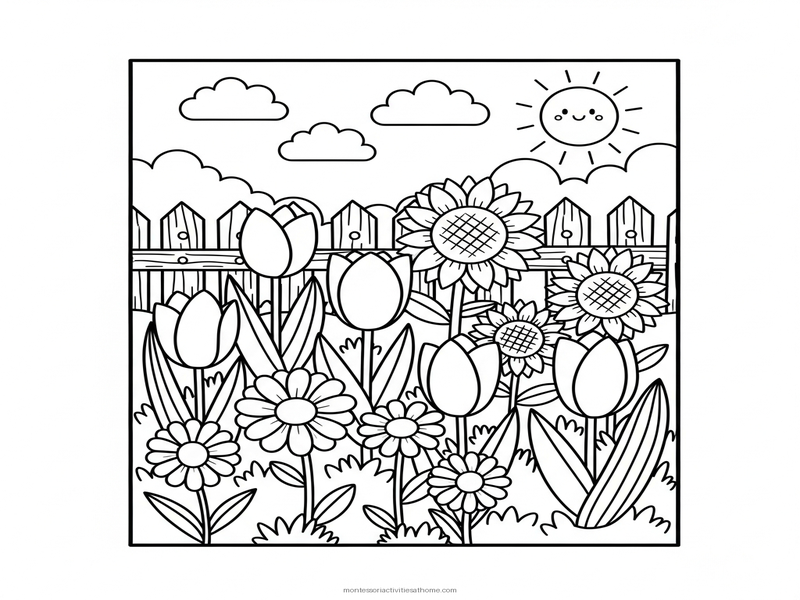
Spring is a season of renewal, and nothing signals its arrival more beautifully than the first flowers pushing through the soil. This coloring page brings a cheerful garden scene to your child's table, featuring three beloved spring flowers — tulips with their smooth, cup-shaped petals, daisies with their sunny centers and delicate radiating petals, and sunflowers standing tall with their broad, seed-filled faces. Together, they offer a rich variety of shapes and sizes that keep children engaged from the first crayon stroke to the last.
Botany is one of the core areas of Montessori cultural studies, and it begins not with textbooks but with real encounters. Maria Montessori believed that children develop a lasting respect for nature when they interact with it directly. This coloring page serves as a bridge between your child and the living world outside your door. As they color a tulip, you can point out how the petals overlap to protect the center of the flower. When they reach the sunflower, talk about how its face follows the sun across the sky — a phenomenon called heliotropism that never fails to amaze young learners.
The variety of flower shapes on this page also provides excellent fine motor practice. Tulips have large, smooth areas ideal for younger children who are still developing pencil control. Daisies demand more precision as your child colors each individual petal without crossing into the center. Sunflowers combine both challenges — broad outer petals surrounding a detailed seed pattern in the middle. This natural progression within a single page means the activity grows with your child, offering appropriate challenge at every skill level.
Skills Practiced
How to Use This Coloring Page
- Go on a flower walk first. Before coloring, take a short walk outside and look for real spring flowers in your yard, neighborhood, or a local park. Let your child touch petals gently, smell the blossoms, and notice the different colors they see. This real-world observation gives the coloring activity purpose and makes color choices more thoughtful and intentional.
- Name the parts of each flower. As your child colors, introduce simple botanical vocabulary: petals, stem, leaves, and center. For older children, you can add "pollen" and "roots" to the conversation. Montessori botany puzzles use exactly this approach — naming the parts of a plant — and your coloring session can mirror that structured learning in a relaxed, creative way.
- Experiment with color blending. Encourage your child to try layering two colors on a single petal — yellow over red to create orange, or blue over yellow for green. This hands-on discovery of color mixing is far more memorable than being told about it. Provide colored pencils for the best blending experience, as they layer more smoothly than crayons or markers.
- Plant a real seed afterward. Extend the activity by planting a sunflower or daisy seed in a small pot. Your child can water it daily and watch it grow, connecting the flat image on the coloring page to the living, growing reality. Tracking the plant's progress over weeks teaches patience, responsibility, and the wonder of the natural life cycle.