Free Printable OT Word Family Worksheets
About This Worksheet
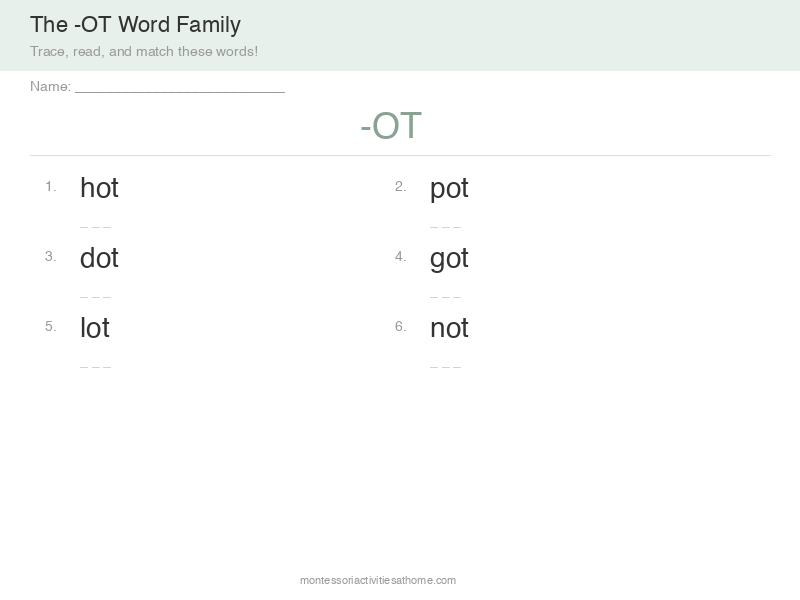
The -OT word family is one of the most practical groups of CVC (consonant-vowel-consonant) words for young readers to learn. Words like hot, pot, dot, lot, got, and not appear constantly in everyday language and in the simple readers that children encounter during their earliest literacy experiences. When a child masters the -OT pattern, they gain the ability to decode an entire cluster of words rather than memorizing each one individually — and that is the real power of word family instruction.
In the Montessori approach, phonics learning is always concrete before it becomes abstract. Before a child traces the word “pot” on this worksheet, they ideally should have held a real pot in their hands, perhaps during a practical life cooking activity. This connection between the physical object and its written name gives the word genuine meaning. The -OT family is particularly well suited to this concrete approach because so many of its words represent tangible, everyday objects — a pot in the kitchen, a dot on a ladybug, a cot for sleeping.
This worksheet includes tracing, reading, and matching exercises that guide children through multiple levels of engagement with each word. Tracing builds the motor memory of letter formation while reinforcing the visual pattern. Reading the words aloud adds the auditory dimension, helping children hear the rhyming pattern that connects hot, pot, dot, lot, got, and not. The matching activity then tests comprehension by asking children to pair each word with its corresponding image, ensuring they understand meaning alongside decoding.
The short “o” sound in the -OT family is one of the five foundational vowel sounds in English. By focusing on this pattern, children strengthen their understanding of how the short “o” behaves in simple words, which prepares them for more complex phonics patterns later. Once they can fluently read -OT words, they are well positioned to tackle -OG, -OP, and -OB families with confidence.
Skills Practiced
How to Use This Worksheet
- Introduce the pattern with real objects. Before starting the worksheet, gather a few -OT items your child can touch — a pot from the kitchen, a dot sticker, or a toy cot. Say each word slowly, emphasizing the “-ot” ending so your child hears the rhyme.
- Trace with proper pencil grip. Guide your child to trace each word using the correct tripod pencil grip. Encourage them to say each letter sound as they write it: “h-o-t” blends into “hot.” This multi-sensory approach connects hand movement, visual input, and auditory processing simultaneously.
- Read the words aloud together. After tracing, point to each word and read it together. Then ask your child to read the list independently. Notice whether they are sounding out each letter or beginning to recognize the -OT chunk as a unit — that shift is a sign of real phonics progress.
- Play a rhyming game afterward. Once the worksheet is complete, take turns thinking of more -OT words. Can your child come up with “rot,” “jot,” or “knot”? This oral extension deepens their understanding of the word family pattern beyond what the page contains.