Free Printable IG Word Family Worksheets
About This Worksheet
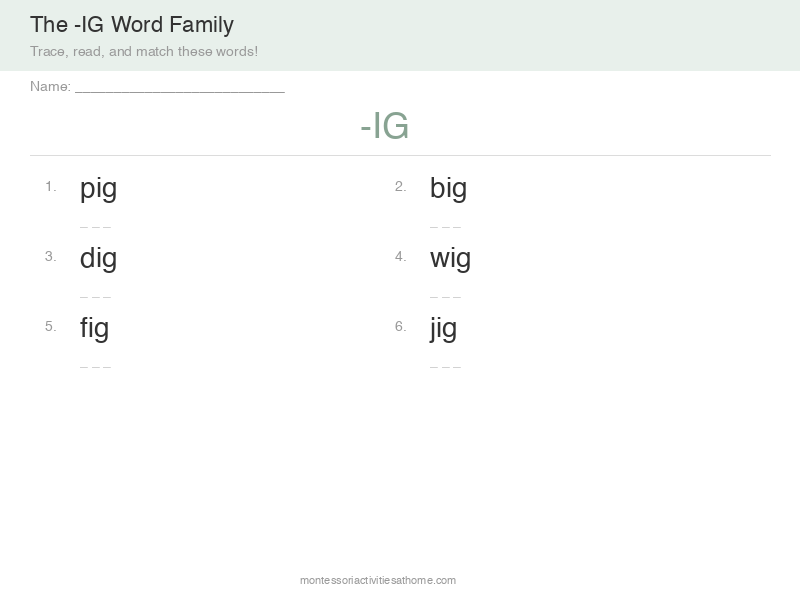
After working with -AT and -AN (which use the short A sound), the -IG family introduces the short I vowel sound — expanding your child's phonics repertoire significantly. This worksheet covers eight -IG words: big, dig, fig, jig, pig, rig, wig, and zig. Some of these words (big, dig, pig) will be immediately familiar, while others (fig, jig, rig) may be new vocabulary, which makes this worksheet a vocabulary builder as well as a phonics exercise.
The short I sound is one that many children find trickier than short A. It lives in the middle of the mouth and can sound similar to short E for some young learners. The repetition in this worksheet — seeing and writing “ig” eight different times with eight different beginning consonants — helps train the ear and eye to recognize this vowel sound reliably.
Word families with less common words (like “fig” and “jig”) offer a bonus opportunity. When your child encounters an unfamiliar word and can still decode it using the pattern, that is a powerful demonstration that their phonics skills work on ANY word, not just the ones they have memorized. This builds reading independence and courage.
Skills Practiced
How to Use This Worksheet
- Introduce the short I sound. Before starting, practice the short I sound together: “ih, ih, ih.” Exaggerate it. Have your child feel how their mouth is positioned differently than for “ah” (short A).
- Define unfamiliar words. Some children may not know what a fig, jig, or rig is. Take a moment to explain: a fig is a fruit, a jig is a dance, a rig is a big truck. Real understanding makes reading more meaningful than just sounding out letters.
- Read the words in silly sentences. “The big pig did a jig in a wig.” These absurd sentences are memorable and make the words stick. Children who laugh while reading learn to associate reading with joy.
- Compare word families. Write “bat” and “big” side by side. Ask your child what is different. This contrastive practice sharpens their ability to distinguish between word families and vowel sounds.