Jungle Animals Coloring Page
About This Coloring Page
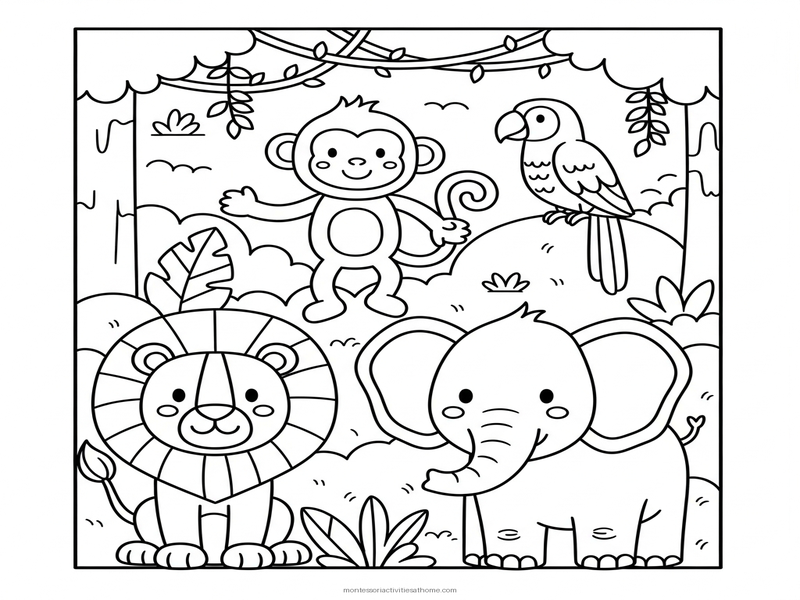
The jungle is one of the most exciting habitats on Earth for young children to explore. It is teeming with animals they have seen in storybooks and at the zoo — majestic lions with flowing manes, playful monkeys swinging from vine to vine, brilliantly colored parrots perched in the canopy, and enormous elephants lumbering through the underbrush. This free printable coloring page brings the tropical jungle to your kitchen table, giving children aged 2 to 6 a scene rich with animals, plants, and textures waiting to be brought to life with color.
Coloring jungle animals provides wonderful practice for fine motor development because each animal presents different textures and shapes. A lion's mane requires small, repeated strokes. An elephant's large body invites broad, controlled coloring within a curved outline. A parrot's feathers call for precise color changes within small sections. In Montessori education, these varied hand movements are understood as indirect preparation for writing — every time your child grips a crayon and controls its path across the page, they are strengthening the muscles and coordination they will later need for forming letters and numbers. The diversity of shapes in a jungle scene means your child practices multiple grip patterns and movement types in a single sitting.
Perhaps the greatest gift of a jungle coloring page is the conversation it inspires. As your child works, you can talk about where jungles are found in the world, what the weather is like in tropical regions, and how jungle animals differ from the animals in your own neighborhood. Montessori education values these organic discussions because they arise from the child's own activity and interest rather than from a textbook. When a child asks "Why does the parrot have so many colors?" while coloring, they are ready to absorb the answer in a way that no flashcard could replicate. Each question becomes a doorway to geography, biology, and environmental awareness — all starting from a single sheet of paper and a box of crayons.
Skills Practiced
How to Use This Coloring Page
- Read a jungle book first. Share a picture book about jungle animals before coloring. Books like "Rumble in the Jungle" or "Walking Through the Jungle" introduce animal names and sounds that your child can recall while coloring. When children connect a story to an activity, both the story and the activity become more memorable.
- Name the animals and their sounds. Point to each animal before coloring and say its name together. Make the animal sounds — a lion's roar, a monkey's chatter, a parrot's squawk, an elephant's trumpet. This multisensory approach engages auditory learning alongside the visual and tactile experience of coloring.
- Choose realistic colors. Talk about what colors each animal really is. Lions are golden-brown, parrots can be red, green, blue, or yellow, and elephants are gray. Encouraging realistic color choices builds observational skills and scientific thinking, though always leave room for imaginative interpretations if your child prefers a purple elephant.
- Sort and classify after coloring. Once the page is finished, ask your child to point to all the animals that have four legs, all the animals that can fly, or all the animals that are bigger than a person. This sorting activity extends the coloring into a classification exercise — a core Montessori skill that develops logical thinking and attention to detail.