Underwater Scene Coloring Page
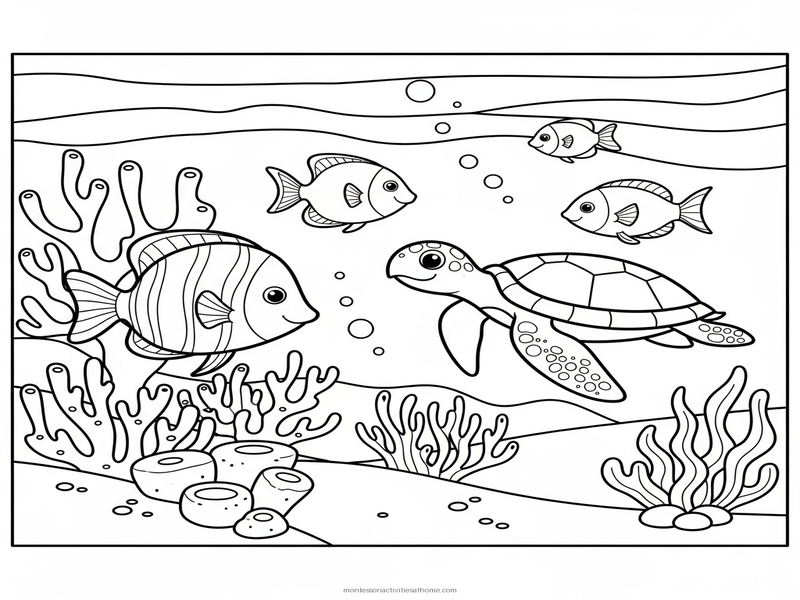
About This Coloring Page
The ocean covers more than 70 percent of our planet, yet it remains one of the most mysterious and awe-inspiring environments on Earth. For young children, an underwater scene is a doorway into a world they rarely see firsthand — a world of shimmering fish, swaying seaweed, ancient coral, and graceful sea turtles gliding through blue water. This free printable coloring page brings that hidden world to your child's table, featuring a richly detailed underwater scene with plenty of marine life for children aged 2 to 7 to color, discuss, and explore.
Coloring an underwater scene offers unique benefits for fine motor development. The varied shapes — the curved shells of sea turtles, the branching structure of coral, the flowing lines of kelp and seagrass — challenge children to adapt their grip and control their movements in different ways. Younger children may color in broad sweeping motions, while older children can work on staying inside the lines of more intricate details like fish scales and coral textures. In Montessori education, this kind of purposeful hand work is valued not only for the physical skill it builds but for the concentration and focus it cultivates. A child absorbed in coloring a coral reef is practicing sustained attention, a skill that transfers to every area of learning.
Beyond motor skills, this coloring page is a launching pad for rich conversations about marine biology and ocean conservation. As your child colors, you can talk about why coral reefs are called the "rainforests of the sea," how sea turtles navigate thousands of miles to return to the beach where they were born, or why clownfish live among the tentacles of sea anemones. These conversations connect art to science in the natural, child-led way that Montessori philosophy encourages. When children learn about an animal while coloring it, the knowledge sticks — anchored by the sensory experience of choosing colors and filling in shapes.
Skills Practiced
How to Use This Coloring Page
- Explore the ocean before coloring. Watch a short, age-appropriate video about coral reefs or look through a picture book about ocean animals. When children have real visual references, their color choices become more thoughtful and their engagement with the page deepens. Even a few minutes of observation transforms coloring from a casual activity into a focused learning experience.
- Name the creatures together. Before picking up a crayon, point to each animal and plant in the scene and name it together: "This is a sea turtle. These are coral. Here is a clownfish." Building vocabulary before coloring gives children words to use as they work and creates natural opportunities for questions and conversation.
- Experiment with blue shades. Offer several shades of blue — from pale sky blue to deep navy — for the water background. Discuss how the ocean gets darker as you go deeper. This simple observation introduces the concept of depth and light in a way that young children can understand and represent through their color choices.
- Create an ocean display. After coloring, cut out individual fish or the entire scene and attach it to a blue poster board to create an underwater mural. Add cotton balls for bubbles or glitter for sparkling water. Turning the coloring page into a craft project extends the learning and gives your child a finished piece they can proudly display.