Greater Than Less Than Worksheet (1-20)
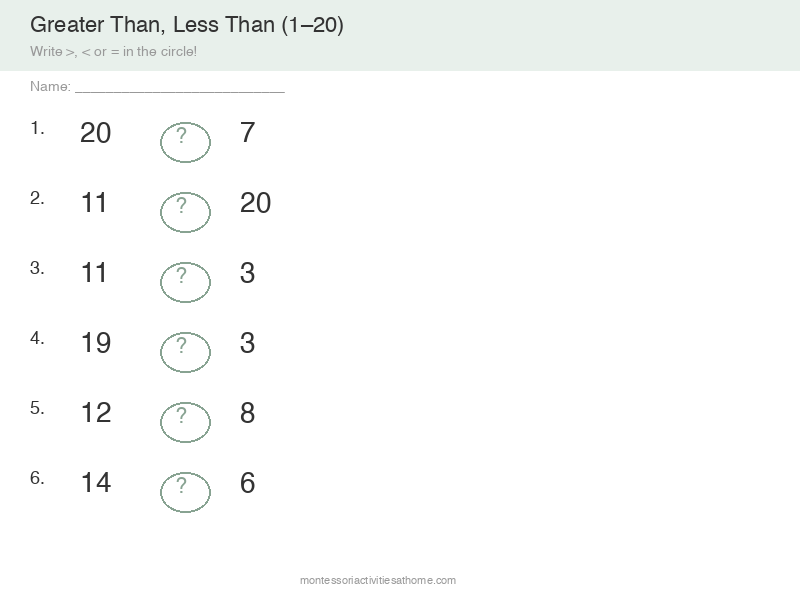
About This Worksheet
Comparing numbers is one of the earliest and most essential mathematical skills a child develops. Before children can add, subtract, or solve word problems, they need to understand that numbers have size — that 14 is more than 9, that 5 is less than 18, and that two quantities can sometimes be exactly equal. This worksheet gives your child structured practice with comparison using numbers from 1 to 20.
The worksheet uses the beloved "alligator method" to make the abstract symbols > and < memorable and fun. Children learn that the hungry alligator always opens its mouth toward the bigger number because it wants the bigger meal. This playful image transforms a confusing pair of symbols into something children genuinely enjoy using. Once they internalize the alligator rule, the correct symbol follows naturally every time.
In Montessori education, comparison begins with concrete materials. Children hold Montessori number rods of different lengths or compare stacks of golden beads to feel the difference between quantities in their hands. This worksheet extends that physical understanding to the written page. Each problem presents two numbers side by side with a blank space between them. Your child decides which number is larger, then writes the correct symbol — or draws the alligator mouth — pointing toward it. Problems progress from simple single-digit comparisons to teen numbers, gradually building confidence with the entire 1-to-20 range.
Skills Practiced
How to Use This Worksheet
- Introduce the alligator. Draw a simple alligator mouth on a whiteboard or scrap paper. Explain that the alligator is very hungry and always wants to eat the bigger number. Show a few examples verbally: "Here is 3 and here is 8. Which one does the alligator want?" Let your child point before writing anything.
- Use objects for tricky pairs. If your child hesitates on a problem — especially with teen numbers like 13 and 17 — set out that many counters in two groups. Seeing the physical difference makes the answer obvious and reinforces what the numbers actually represent.
- Work through problems one row at a time. Covering the rest of the page with a blank sheet of paper reduces visual overwhelm and helps your child focus on a single comparison. Celebrate each correct answer to build momentum.
- Check for equal pairs. Some problems on the worksheet include two identical numbers. Watch whether your child recognizes that neither number is bigger and uses the equals sign. Understanding equality is just as important as understanding inequality and often surprises children who expect every pair to have a winner.