Ten Frames Counting Worksheet
About This Worksheet
A ten frame is a simple rectangular grid with two rows of five boxes — ten spaces in total. Despite its simplicity, this humble tool is one of the most researched and effective visual models in early mathematics education. Ten frames help children see numbers not as abstract symbols but as real quantities with structure, building the kind of deep number sense that supports all future math learning.
When a child looks at a ten frame showing 7 dots, they do not need to count each one individually. They can see that the top row is full (that is 5) and the bottom row has 2 filled (so 5 and 2 more is 7). This ability to recognize a quantity at a glance is called subitizing, and it is a critical milestone in mathematical development. Children who can subitize move through arithmetic more fluently because they spend less mental energy on basic counting and more on problem-solving.
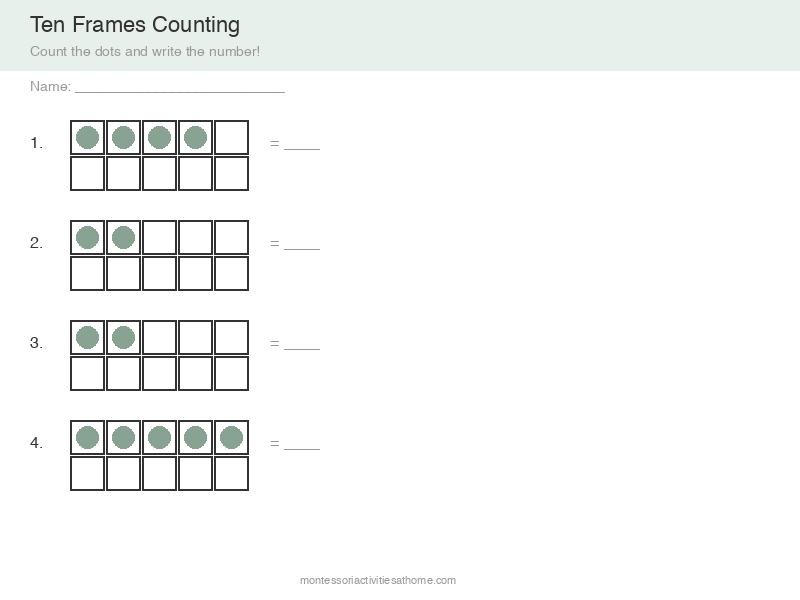
This worksheet presents a series of ten frames in increasing order from 1 to 10. Some frames have dots already placed; your child counts them, draws additional dots if prompted, and writes the corresponding numeral beside each frame. The visual layout naturally reinforces the relationship between each number and 10 — a child working on the number 4 can see 6 empty boxes and begin to sense that 4 + 6 = 10, even before they have been formally taught addition. In Montessori terms, this is indirect preparation: the material plants seeds of understanding that blossom later.
Skills Practiced
How to Use This Worksheet
- Build it first with real objects. Before using the printed page, make a ten frame from an egg carton (cut down to 10 cups) or draw one on paper. Let your child place small objects — pom-poms, coins, or cereal pieces — into the frame. This hands-on step makes the worksheet an extension of real experience rather than an isolated exercise.
- Always fill from top-left. Guide your child to place dots starting at the top-left and moving across before dropping to the second row. Consistent placement builds the visual patterns that make subitizing possible — a child who always fills frames the same way learns to instantly recognize what 6 or 8 looks like.
- Ask about the empty spaces. After your child fills a frame, point to the empty boxes and ask, "How many spaces are left?" This simple question introduces subtraction from 10 without any formal instruction and directly supports future work with number bonds.
- Extend with games. Once the worksheet is complete, play "flash frame" — show a completed ten frame for two seconds, then cover it and ask your child to say the number. This playful challenge develops instant recognition and makes the learning feel like a game rather than schoolwork.