Diagonal Letter Tracing Worksheet | Free Printable
About This Worksheet
Diagonals are genuinely harder than straight lines or curves, and children who breezed through L and O often stall here. The reason is motor planning rather than strength: a diagonal requires moving in two directions at once and judging an angle, which develops noticeably later than the ability to draw a straight line down. If your child finds these frustrating, they are not behind — they have simply arrived here early.
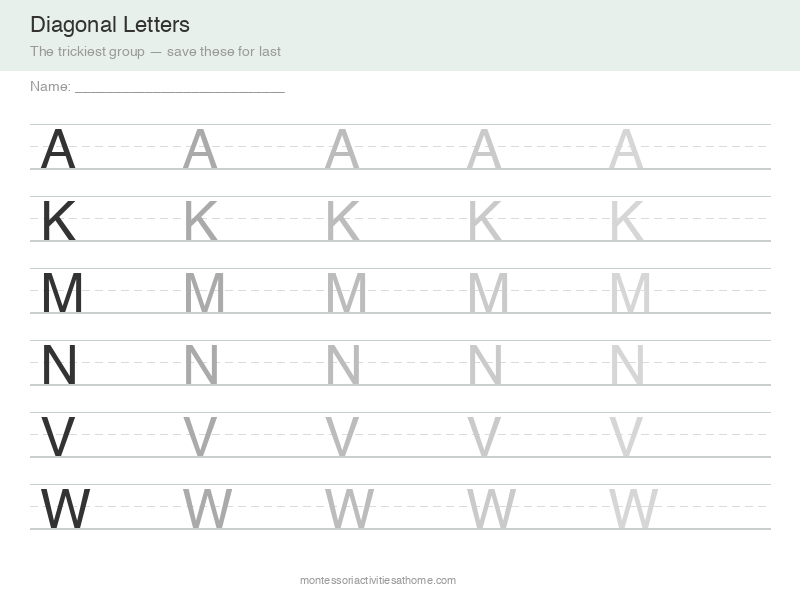
A, K, M, N, V and W all share that angled stroke, so they are worth teaching as a set once your child is confident with the other two groups. V is the gentlest entry point: two strokes, meeting at a point, nothing else to hold in mind. M and W are the hardest, because they ask for four changes of direction without losing the letter's proportions.
This sheet suits four to six year olds, and often sits alongside the start of kindergarten. If your child is younger and struggling, put it away for a month or two and come back — waiting works better here than practice does.
Skills Practiced
How to Use This Worksheet
- Start with V, finish with M and W. The sheet runs alphabetically, but the difficulty order is V, A, N, K, W, M. Follow the difficulty, not the alphabet.
- Use the guidelines as targets. A diagonal is much easier to judge when your child aims for a specific point on the baseline rather than drawing at an angle in mid-air.
- Break M and W into counted strokes. “Down, up, down, up.” Counting the strokes aloud gives the hand a rhythm and stops the letter collapsing halfway through.
- Come back to it. Of all the letter groups, this is the one that most rewards leaving alone for a few weeks. The jump when it clicks is usually dramatic.