Free Printable ORE Word Family Worksheets
About This Worksheet
The -ORE word family introduces children to a vowel-r pattern that works differently from the long and short vowel sounds they have practiced in other word families. In -ORE words, the “o” and “r” combine to create a unique sound that is neither the long “o” of “home” nor the short “o” of “hot.” This r-controlled vowel pattern is sometimes called a “bossy r” because the “r” changes how the vowel sounds. Learning the -ORE family gives children a strong foundation for understanding how r-controlled vowels work throughout English, from “more” and “store” to “explore” and “shore.”
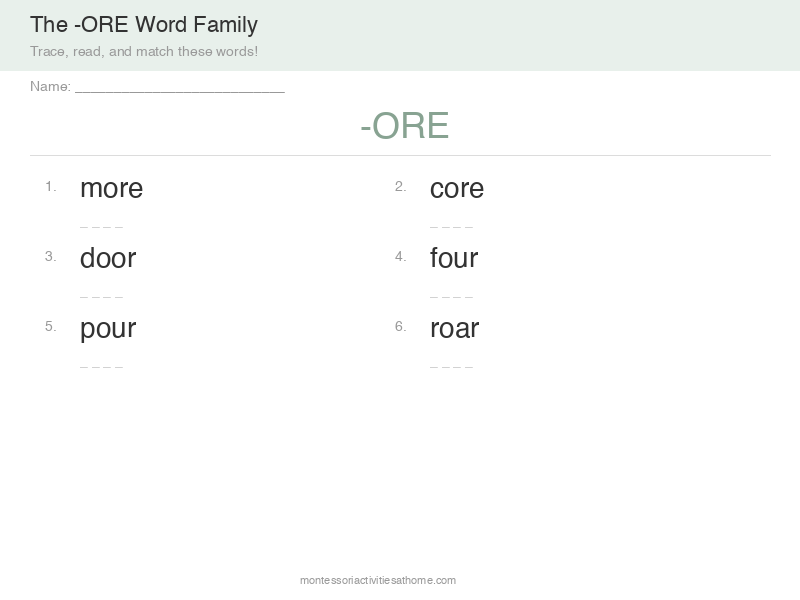
This worksheet features ten -ORE words that span a range of complexity: more, core, store, score, bore, tore, wore, shore, snore, and explore. The simpler four-letter words like “bore,” “tore,” and “wore” provide an accessible entry point, while words beginning with consonant blends like “store,” “score,” “shore,” and “snore” add challenge for children who are ready. The inclusion of “explore” — a two-syllable word — stretches readers even further and introduces the concept that word family patterns can appear within longer, multi-syllable words.
The Montessori approach emphasizes real-world connections in all learning, and the -ORE family offers many opportunities for this. A trip to the store, a walk along the shore, keeping score in a game, or exploring the backyard — these are experiences that give -ORE words tangible meaning. When children can connect the word “shore” to the feeling of sand between their toes or “store” to the place where they help choose groceries, the reading becomes personally meaningful rather than abstract.
Skills Practiced
How to Use This Worksheet
- Introduce the “bossy r” concept. Before starting, explain that when “r” comes after a vowel, it changes the vowel’s sound. Say “or” and “ore” aloud so your child can hear the r-controlled vowel. Then read through the word bank together, emphasizing how every word shares that same “-ore” ending sound.
- Trace with attention to letter formation. Guide your child to trace each -ORE word while saying it aloud. Pay special attention to the “r-e” ending — many children want to drop the silent “e.” Remind them that the “e” is quiet but important, just like in the -AKE and -INE families they may have already practiced.
- Act out the words. Many -ORE words describe actions or experiences that children can dramatize. Pretend to snore while sleeping, act out exploring a new place, or mime opening a store. This kinesthetic approach helps children remember both the meaning and the spelling of each word.
- Build sentences together. After the worksheet is complete, create simple sentences using multiple -ORE words: “I wore my shoes to the store.” “We kept score at the shore.” This oral language activity reinforces the rhyming pattern and shows children how these words function in everyday communication.