Free Printable INE Word Family Worksheets
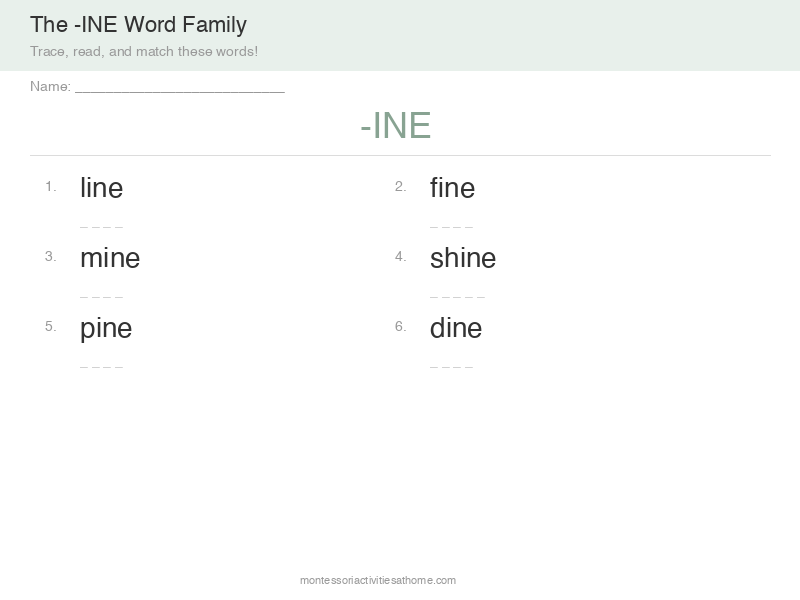
About This Worksheet
The -INE word family is a rich collection of long vowel words that follows the same CVCe (consonant-vowel-consonant-silent e) pattern children encounter in the -AKE family, but with the long “i” sound instead. Words like line, mine, fine, pine, vine, nine, dine, shine, spine, and twine are woven throughout everyday English, appearing in stories, conversations, and instructions. When a child learns that changing the first letter or letters before “-ine” creates a completely new word, they unlock a powerful decoding strategy that carries far beyond this single worksheet.
Montessori literacy instruction emphasizes patterns and connections rather than rote memorization. The -INE family is especially useful for this purpose because it naturally introduces children to consonant blends at the beginning of words. While “line,” “mine,” and “fine” start with single consonants, “shine,” “spine,” and “twine” begin with two-letter blends. This built-in progression allows a child to start with the simpler words and gradually tackle the more challenging ones, all within the safety of a familiar rhyming pattern. The consistent “-ine” ending acts as an anchor, giving children confidence even as the onset becomes more complex.
Many -INE words also connect beautifully to nature and the outdoor environment that Montessori philosophy values so deeply. Pine trees, grape vines, and twine for garden projects are all tangible objects a child might encounter during nature walks or practical life activities. Pointing out these connections transforms the worksheet from a phonics exercise into a bridge between reading and the real world, reinforcing vocabulary through lived experience.
Skills Practiced
How to Use This Worksheet
- Start with the long “i” sound. Say the word “mine” slowly and ask your child to listen for the vowel sound in the middle. Compare it to a short “i” word like “pin” versus “pine.” This contrast helps children hear how the silent “e” changes the vowel sound, setting the stage for all ten -INE words on the worksheet.
- Trace and read aloud. Have your child trace each word carefully while saying it. Encourage them to blend the sounds together rather than spelling letter by letter: “l-ine” not “l-i-n-e.” This onset-rime approach reinforces the word family pattern and builds reading speed.
- Connect words to real objects. After completing the tracing, go on a mini scavenger hunt. Can your child find a line on the floor, the number nine on a clock, or a pine cone outside? Matching written words to real-world objects strengthens vocabulary retention far more than paper practice alone.
- Create rhyming sentences. Challenge your child to use two or three -INE words in one sentence: “The vine had nine leaves.” “I drew a fine line.” This creative exercise builds both reading fluency and oral language skills while making the rhyming pattern memorable and fun.