Body Parts Word Search | Free Printable
About This Worksheet
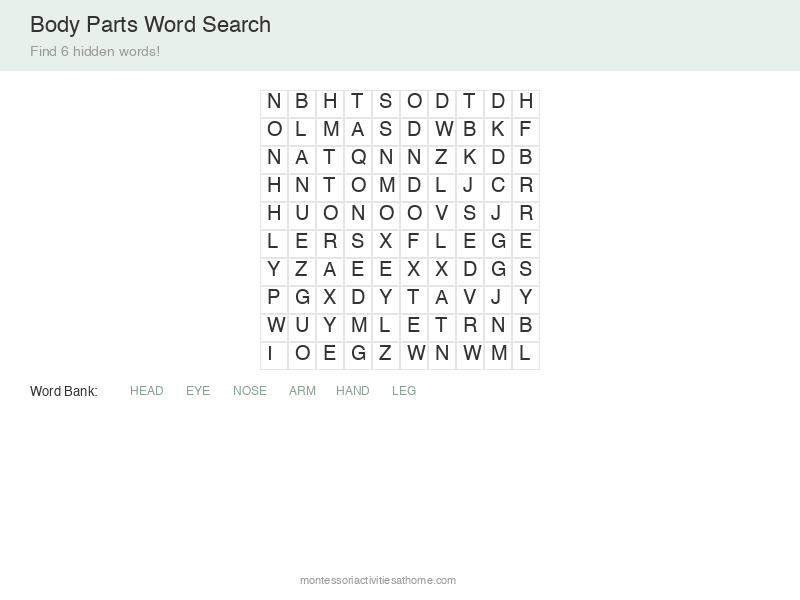
Learning the names of body parts is one of the most fundamental vocabulary tasks for young children, and it connects directly to both science and self-awareness. This word search hides 10 common body part words — hand, foot, head, arm, leg, knee, nose, ear, eye, and back — inside a letter grid designed for children ages 5 to 7. Most of the words are short CVC or CVCC patterns, making them accessible for early readers while still requiring careful visual scanning to locate in the puzzle.
In the Montessori approach, the human body is introduced through sensorial experiences long before worksheets enter the picture. Children learn about their senses by tasting, touching, smelling, seeing, and hearing. They trace sandpaper letters with their fingers and pour water with their hands. By the time they encounter this word search, words like “hand” and “ear” already carry rich meaning built from years of direct experience. The worksheet simply adds the written dimension to knowledge the child already owns, reinforcing the connection between the spoken word and its printed form.
This worksheet also doubles as an introduction to basic health science. While searching for words, children can point to each body part on themselves, building the mind-body vocabulary connection that supports everything from following a doctor’s instructions to describing how they feel when something hurts. Naming body parts accurately is a life skill, and practicing it through a word search makes the learning feel like a game rather than a lesson.
Skills Practiced
How to Use This Worksheet
- Play a body part warm-up game. Before starting the worksheet, play “Simon Says” using only body part words from the puzzle: “Simon says touch your knee,” “Simon says wiggle your nose.” This kinesthetic warm-up activates the vocabulary your child will need to recognize in print.
- Read the word bank together. Point to each word and read it aloud. For words with tricky spellings like “knee” (silent K) or “eye” (unusual vowel pattern), take a moment to discuss the spelling. This turns the word search into a phonics mini-lesson.
- Search and point. As your child finds each word in the grid, ask them to point to that body part on themselves. This physical connection reinforces both the vocabulary and the reading, creating a multi-sensory learning loop that strengthens memory.
Not sure this is the right level? Our guide to free printable word search puzzles for kids walks through every age in turn — see what to expect from a word search for 5 year olds or a word search for 7 year olds, and which puzzle to print next.