Counting by 10s Worksheet and Hundred Chart
About This Worksheet
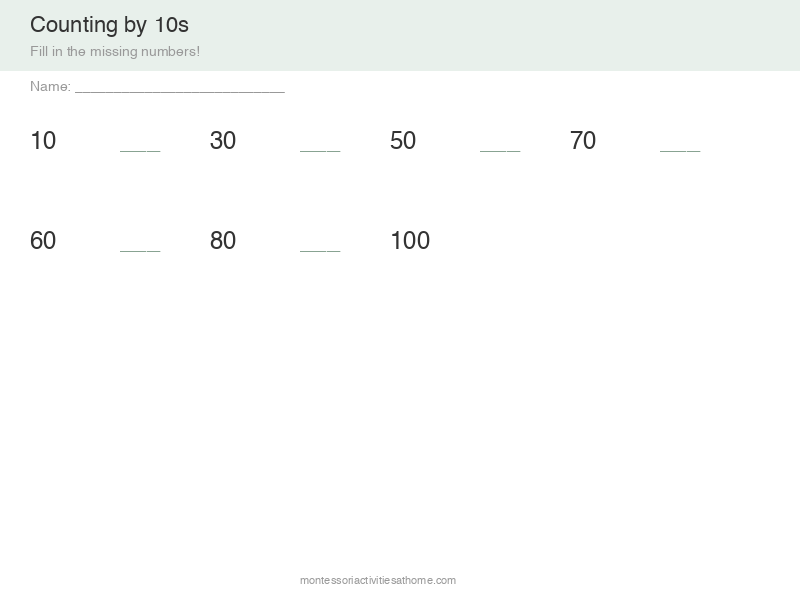
Counting by 10s is the gateway to understanding our entire base-ten number system. When a child chants "10, 20, 30, 40..." they are not simply memorizing a sequence — they are discovering the fundamental pattern that governs how numbers are organized, how place value works, and how larger quantities can be managed efficiently. This free printable counting by 10s worksheet offers children aged 4 to 7 multiple ways to explore the 10s pattern through number charts, fill-in-the-blank sequences, and hands-on grouping activities.
In Montessori classrooms, the ten-bar is one of the earliest and most frequently used materials. Children hold a bar of ten golden beads in their hand, feeling its weight and length compared to a single unit bead. They line up ten-bars to build quantities like 30, 50, or 100, physically experiencing what it means to have three groups of ten or five groups of ten. This worksheet extends that tactile understanding to paper, presenting visual groups of ten objects that children count, circle, and label. The hundred chart activities help children see where multiples of 10 fall in the broader number landscape, building spatial awareness of number relationships.
Mastering the 10s count has practical benefits that children notice immediately. Counting dimes, reading decades on a number line, and understanding that 100 is made of ten groups of 10 all become accessible once this pattern is secure. The worksheet also introduces early place value concepts by asking children to identify the tens digit in two-digit numbers — a gentle introduction that prepares them for more formal place value instruction. When children understand that the "3" in 30 means "three tens," they have grasped one of the most important ideas in elementary mathematics, and every future lesson on addition, subtraction, and beyond becomes easier to understand.
Skills Practiced
How to Use This Worksheet
- Build groups of ten first. Give your child a bowl of small objects — dried beans, paperclips, or buttons — and ask them to sort them into groups of 10. Count each group together: "One group of ten is 10, two groups of ten is 20..." This concrete experience gives meaning to every number on the worksheet.
- Chant the sequence with rhythm. Counting by 10s has a satisfying rhythm. Clap on each number as you count together to 100. Once the sequence is fluent, try starting from different points: "What comes after 50? What comes before 80?" This flexibility shows that your child truly understands the pattern rather than just reciting from the beginning.
- Color the hundred chart. Have your child color or highlight every multiple of 10 on the hundred chart. Ask them what they notice about where those numbers appear — they form a straight column on the right side. This visual pattern reinforces the idea that every multiple of 10 ends in zero, connecting skip counting to numeral reading.
- Connect to daily life. Point out counting by 10s in real situations: counting coins, reading a thermometer, checking the time in ten-minute intervals, or counting items packaged in groups of 10. These everyday connections make the abstract pattern feel relevant and motivate continued practice.