Skip Counting by 5s Worksheet
About This Worksheet
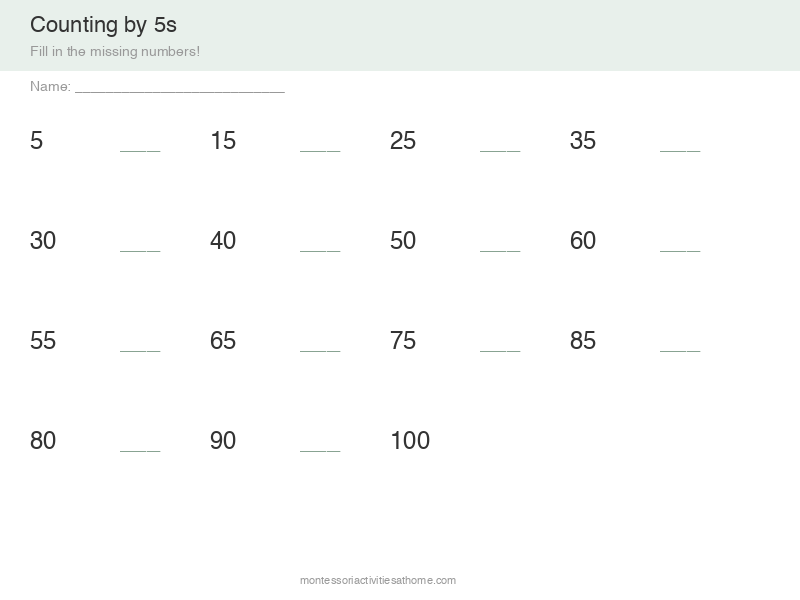
Skip counting by 5s is one of the first number patterns children discover, and it connects beautifully to something they carry with them everywhere — their own two hands. Every child knows they have five fingers on each hand, making counting by 5s feel intuitive and personal. This free printable counting by 5s worksheet uses number lines, fill-in-the-blank sequences, and hands-on tracing activities to help children aged 4 to 6 master the 5s pattern: 5, 10, 15, 20, 25, and beyond.
In Montessori education, skip counting is introduced through the bead chains — long chains of colored beads grouped in sets of five, with small numbered arrows marking every fifth bead. Children physically touch and count each bead group, absorbing the pattern through movement and touch before they ever see it written on paper. This worksheet brings that same sequential discovery to your home by presenting the 5s pattern in multiple formats. Number line activities let children see the even spacing between multiples of 5, while fill-in-the-blank exercises challenge them to predict the next number in the sequence.
Beyond building a foundation for multiplication, counting by 5s has everyday applications that make it especially rewarding to practice. Children who can count by 5s are ready to read analog clocks, count nickels, and tally groups efficiently. When your child counts 5, 10, 15, 20 while looking at a clock face, they are simultaneously learning time, skip counting, and the concept of equal intervals. These connections across subjects are a hallmark of Montessori learning, and they give children a powerful sense that mathematics is not an isolated school subject but a tool for understanding the real world around them.
Skills Practiced
How to Use This Worksheet
- Count fingers first. Hold up both hands and count fingers together by 5s: "Five, ten!" Then involve siblings or stuffed animals to extend the count: "Five, ten, fifteen, twenty." This physical warm-up primes your child for the patterns on the worksheet and builds confidence before they pick up a pencil.
- Trace along the number line. Have your child place a finger on the first number and hop along the number line, saying each multiple of 5 aloud. Emphasize the rhythm — skip counting has a musical quality that helps children remember the sequence. Clapping or tapping the table on each number adds a kinesthetic element.
- Fill in the missing numbers. For the fill-in-the-blank sections, encourage your child to say the full sequence aloud and stop when they reach the blank. If they get stuck, remind them to use the pattern: "What comes after 15 if we keep adding 5?" Let them use fingers to count up from the last known number if needed.
- Extend with real-world practice. After completing the worksheet, find opportunities to count by 5s throughout the day. Count tally marks, sort coins into groups of five, or count down from 50 by 5s during transitions. The more contexts children encounter skip counting, the more deeply the pattern embeds itself in their memory.