Subtraction Within 20 Worksheet
About This Worksheet
Subtraction is often the first mathematical operation that challenges young learners, because it asks them to think in reverse. Instead of combining groups, children must start with a whole and remove part of it — a concept that requires a different kind of reasoning than addition. This free printable worksheet introduces subtraction within 20 using visual crossing-out activities and written number sentences, giving children aged 5 to 7 a supported path toward subtraction fluency.
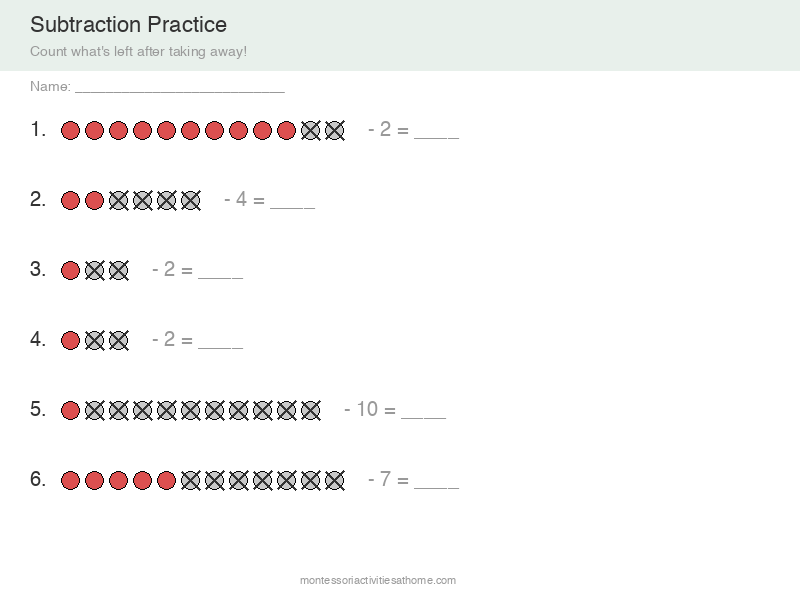
Each problem on this worksheet presents a group of objects alongside a subtraction number sentence. Your child counts the starting group, crosses out the number being subtracted, and then counts the remaining objects to find the difference. This crossing-out method mirrors how Montessori classrooms teach subtraction with physical materials — children literally take beads away from a group and observe what remains. The visual approach ensures that subtraction is understood as a meaningful action rather than an abstract symbol exercise.
As children work through the problems, they encounter subtraction facts that build on their knowledge of number bonds and addition. A child who knows that 8 + 5 = 13 can begin to see that 13 - 5 = 8, recognizing subtraction as the inverse of addition. This relationship is one of the most important insights in early mathematics, and repeated practice with concrete and visual subtraction problems makes it emerge naturally. Over time, your child will move from counting each remaining object to recalling subtraction facts from memory, building the mental math fluency they need for more complex problem solving.
Skills Practiced
How to Use This Worksheet
- Start with a hands-on demonstration. Place 15 small objects on the table. Tell your child a simple story: "There were 15 apples in a basket, and we ate 6. How many are left?" Have them physically remove 6 objects and count the rest. This real-world connection makes the worksheet problems meaningful.
- Model the crossing-out technique. Show your child how to draw a neat X through each object being subtracted. Encourage them to cross out carefully and count as they go: "One crossed out, two crossed out, three..." This systematic approach prevents errors and builds methodical thinking habits.
- Write the complete number sentence. After finding the answer, ask your child to read the full equation aloud: "Fourteen minus six equals eight." Hearing and speaking the mathematical language reinforces vocabulary and helps children internalize the structure of subtraction.
- Connect subtraction to addition. After your child solves a problem like 16 - 9 = 7, ask: "What addition problem does this remind you of?" Helping children see that 7 + 9 = 16 strengthens their understanding of fact families and builds flexible number thinking.