Addition Within 20 Worksheet
About This Worksheet
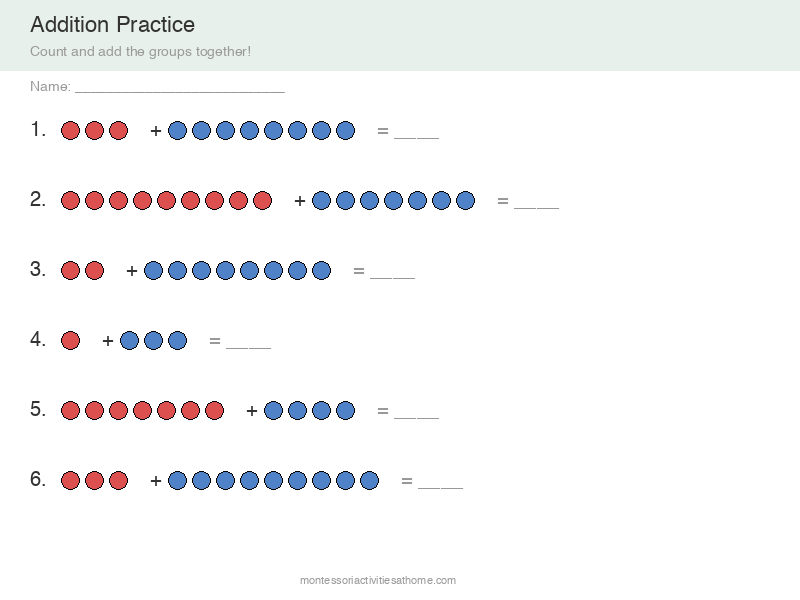
Once children have mastered addition facts to 10, the natural next step is extending that confidence to sums within 20. This worksheet provides carefully structured addition problems that help kindergartners and first graders build fluency with number sentences like 8 + 7, 9 + 6, and 12 + 5. Each problem is accompanied by visual aids — grouped counters and simple illustrations — so children can verify their answers by counting when they need extra support.
In Montessori education, addition is first experienced through physical materials such as golden beads and the addition strip board. Children physically combine two groups and count the total, developing an understanding of what addition truly means before memorizing facts. This worksheet extends that hands-on approach by offering visual representations alongside written number sentences, allowing your child to transition gradually from concrete to abstract thinking. The problems progress in difficulty, beginning with smaller addends and moving toward combinations that require bridging through 10.
Bridging through 10 is a key mental math strategy that transforms how children approach larger sums. When faced with 8 + 5, a child who understands number bonds can decompose 5 into 2 + 3, add 2 to 8 to make 10, and then add the remaining 3 to reach 13. This worksheet gives children repeated opportunities to practice this strategy in a supportive, low-pressure format. As fluency grows, your child will begin solving these problems from memory rather than calculation — a milestone that opens the door to multi-digit addition and more advanced mathematical thinking.
Skills Practiced
How to Use This Worksheet
- Warm up with manipulatives. Before starting the worksheet, give your child 20 small objects such as beads, buttons, or dried pasta. Let them practice combining groups physically — put 9 in one pile and 4 in another, push them together, and count the total. This concrete step makes the written problems feel familiar rather than abstract.
- Read each problem aloud. Point to the first number, the plus sign, and the second number. Ask your child to say the full number sentence: "Eight plus five equals..." Verbalizing the problem engages auditory memory and helps children internalize the structure of addition.
- Use the visuals for support. Encourage your child to count the picture counters if they are unsure of an answer. Over time, they will rely on the pictures less and less as mental strategies take over. Never rush this transition — confidence comes before speed.
- Celebrate strategies, not just answers. When your child explains how they solved a problem — whether by counting on, using doubles, or bridging through 10 — praise the thinking process. Understanding multiple strategies builds flexible mathematical reasoning that serves children far beyond this worksheet.